Mobile App Development Trends Businesses Must Know 2026

mobile-app-development-trends-2026

If you think having an app is enough to build an online presence, I am sorry to say you’re headed in the wrong direction. Because it needs the right app, flawless software that fits your targeted niche, and a leading mobile app development company that understands your business goals. The business’s growth today depends on how well its app connects with target users, streamlines operations, and keeps things moving in a highly competitive market. 

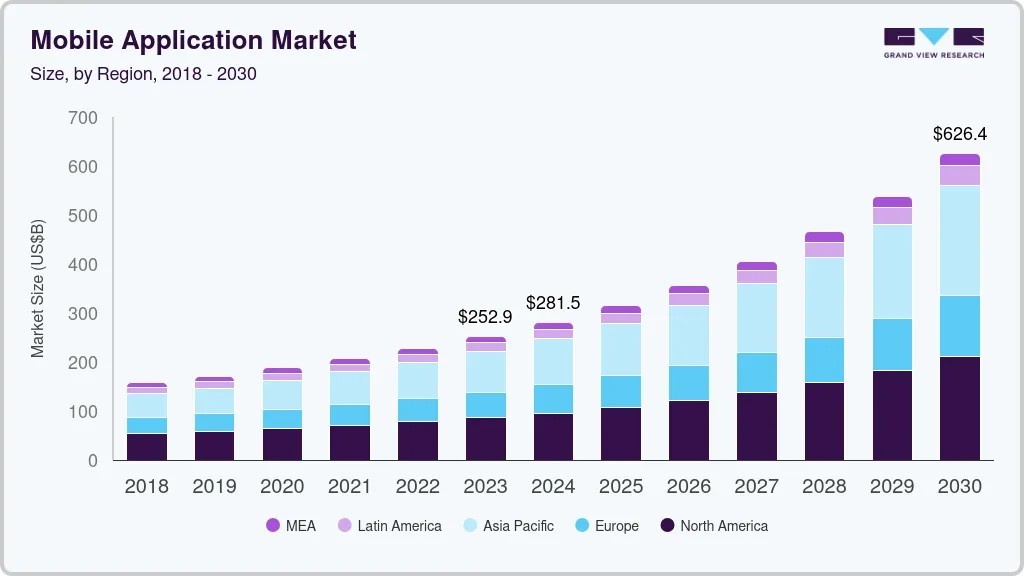
According to Grand View Research, the global mobile application market was valued at USD 252.89 billion in 2023 and is projected to reach USD 626.39 billion by 2030, growing at a CAGR of 14.3% from 2024 to 2030. These numbers clearly show how deeply mobile experiences now shape how businesses operate and how people interact with brands every day.

Users raised the bar; they don’t want just an app; they want something that feels personal, quick, and smooth, using AI, AR/VR, 5G, and cloud technology to make each tap feel effortless. If you are planning to grow your digital presence, 2026 is the right time to execute your plans. In this blog, we will discuss the latest mobile app development trends for 2026 and how to choose the best one for your business. 

Top 12 Mobile Apps Development Trends in 2026 

The following is the comprehensive list of the top 12 mobile app development trends in 2026 that every business should know.

(1) AI Native and On-device Intelligence 

AI has moved from backend support to the core architecture of mobile apps. What is changing in 2026 is where AI operates on-device instead of purely cloud-based. This means apps can process data locally, making them faster, more secure, and highly responsive, even without internet connectivity. 

What this looks like in real life: 

  • Apps adapting layouts based on user habits
  • Auto-reply suggestions to messaging apps 
  • Real-time photo improvement without uploading raw images 
  • Voice assistants working offline 
💯 Fact Check 
Apps using on-device AI can reduce latency by up to 60% to 80% compared to cloud-dependent models.
User BenefitsEnterprise Benefits
Instant responses without lag, even in low connectivity areas.Reduced dependency on cloud infrastructure lowers long-term costs.
Stronger privacy since data stays on the device.Better compliance with strict data protection regulations.
Offline functionality for key features.Improved app reliability and uptime.
Personalized experience that grows in real time.Higher user engagement due to smarter interactions.

(2) 5G-enhanced Mobile Experiences

Here, 5G is not just showing high speed, but it is all about offering experiences that were previously not possible on mobile devices. Enabling ultra-low latency and high bandwidth, apps can now offer real-time and data-heavy interactions seamlessly. 

Where users feel the difference:

  • Buffer-free 4K and 8K video streaming 
  • Lag-free multiplayer gaming 
  • Real-time AR navigation 
  • Instant cloud sync
User BenefitsEnterprise Benefits
Lightning-fast app loading and smooth navigation.Ability to build high-performing and feature-rich apps.
Seamless streaming and gaming without interruptions.Increased user satisfaction and app ratings.
Real-time collaboration and communication.Better engagement metrics and session duration.
Improved AR/VR experiences.Opportunity to develop new ideas with comprehensive features

(3) Cross-platform & Low-code/No-code Development 

Speed is the topmost priority in apps nowadays. Cross-platform development ensures apps run on multiple OS (operating systems) using a single codebase, while low-code or no-code tools simplify the development process. This combination is making app development quick, more efficient, and scalable. 

Many businesses are now collaborating with an experienced app development company like iQlance Solutions to leverage these tools without compromising quality. 

Why is this trend growing?

  • Quicker prototyping and deployment 
  • Reduced development complexity 
  • Easier updates across platforms
User BenefitsEnterprise Benefits
Uniform experience across Android and iOS devicesSignificant reduction in development time
Faster feature updates and bug fixingLower development and maintenance costs
Stable and consistent performanceFaster go-to-market strategy
Better app reliabilityEasier scalability for future features

(4) Touchless UI 

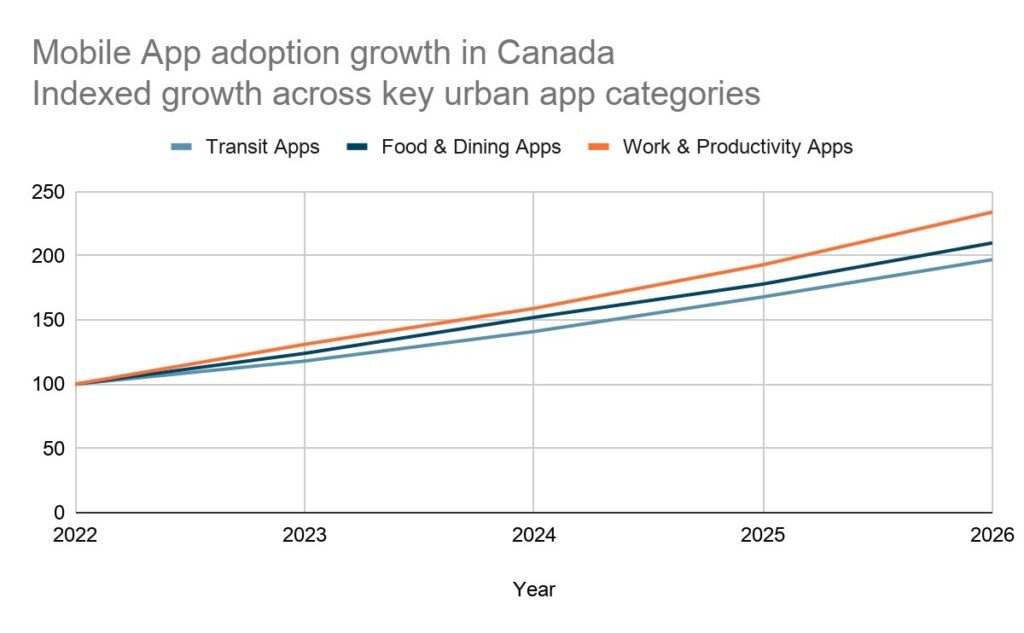
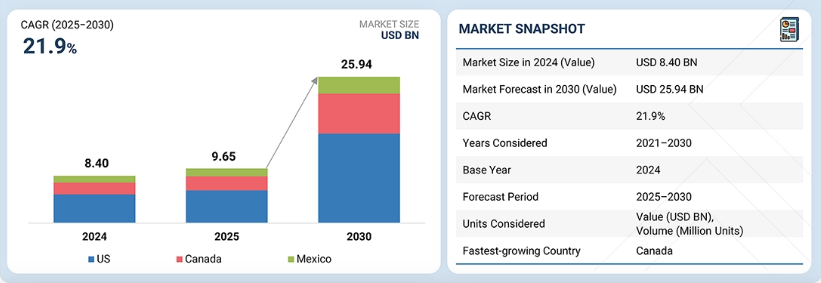
The trend of touchless UI is growing rapidly, and users are widely expecting it in mobile apps. Because touchless interfaces are transforming how users interact with apps. Instead of tapping screens, users can now control apps using voice, gestures, or even facial recognition (the latest update). This trend is making apps more intuitive, accessible, and convenient. The following image shows the growth of touchless UI in the US, Canada, and Mexico.

💯 Fact Check  
Voice-based interactions are expected to power over 50% of mobile searches in the near future.
User BenefitsEnterprise Benefits
Interaction improves convenience in daily use because there is no need to use your handsExpands accessibility for differently-abled users 
Faster task completion without manual inputIncreased adoption across wider user segments 
Improved hygiene and safety in public environmentsHigher engagement due to ease of use
More natural and intuitive app navigationStronger brand perception as innovative 

(5) Hyper-personalization With AI Analytics 

Nowadays, users expect apps to feel ‘custom-made’ for them. Hyper-personalization uses AI and data analytics to customize every aspect of the app experience. This goes far beyond simple recommendations; it reshapes the entire user journey. 

How apps personalize experiences:

  • Dynamic content feeds 
  • Personalized notifications 
  • Behavior-based UI changes 
  • Predictive suggestions
User BenefitsEnterprise Benefits
Contact and features custom to individual preferencesHigher conversion rates and sales
Reduced time spent searching for relevant information Better understanding of user behavior
More meaningful and engaging interactions Increased retention and lifetime value
Personalized offers and recommendationsImproved ROI from marketing efforts
Future outlook: 

The global hyper-personalization market is projected to grow from US $25.73 billion in 2025 to US $58.34 billion by 2030. This reflects strong demand for intelligent personalization solutions.

(6) Apps For Foldable and Wearable Devices 

With the growing demand for foldable smartphones and wearable devices like smartwatches, apps must now adapt to multiple screen sizes and interaction styles. This trend is pushing developers to think beyond traditional layouts. Teams specializing in app development Toronto are already focusing on adaptive UI/UX for these emerging devices. 

What’s changing:

User BenefitsEnterprise Benefits
Smooth experience across various device typesAccess to new and growing device markets
Better multitasking capabilitiesOpportunities to innovate with unique app features
Improved usability on smaller screensIncreased user engagement across devices
Seamless device connectivityFuture-proof app development strategy

(7) Predictive Analytics 

Predictive analytics allow apps to think ahead. Instead of reacting to user actions, apps anticipate needs and provide proactive solutions. 

Actual applications:

  • Predict the next purchase 
  • Suggesting routes based on traffic patterns 
  • Recommending content before search
User BenefitsEnterprise Benefits
Reduced effort in searching or navigatingMore accurate targeting and recommendations
Faster decision-making with relevant suggestionsIncreased conversions and sales
Smarter and more intuitive app experienceData-driven product improvements
Time-saving interactionsStronger competitive positioning

(8) Extended Reality (XR) 

Extended Reality (AR, VR, and MR) is turning mobile apps into immersive environments where users can interact with digital content in real-world contexts. 

Where users see XR:

  • Virtual try-ons in shopping apps 
  • Interactive gaming experiences 
  • AR-based learning tools
  • Virtual tours and simulations
💯 Fact Check  
XR adoption in mobile apps is growing rapidly, with user engagement increasing by over 40% in comprehensive experiences.
User BenefitsEnterprise Benefits
Highly interactive and engaging experiencesStrong differentiation in crowded markets
Better visualization before making decisionsIncreased conversion rates
Improved learning and entertainmentImproved customer engagement
Real-world interaction with digital contentInnovative brand positioning

(9) Advanced Mobile Security and Privacy 

Security is not an option; it is a fundamental expectation. Users demand transparency and control over their data. Cutting-edge apps are implementing advanced security measures to protect sensitive information. 

Leading mobile app development companies in Canada use various cutting-edge technologies, including biometric authentication (fingerprint, face ID, or more), end-to-end encryption, secure APIs, and zero-trust architecture, to ensure high-tech security of the application.

💯 Fact Check  
Over 80% of users are more likely to trust apps that clearly communicate data protection practices.
User BenefitsEnterprise Benefits
Strong protection of personal and financial dataReduced risk of cyberattacks and breaches
Secure transactions and communicationCompliance with global regulations
Greater control over privacy settingsIncreased user trust and loyalty
Compliance with data-protection law ensures data is safe while using appsStronger brand credibility

(10) Blockchain and IoT-Integrated Mobile Apps 

The combination of blockchain and IoT builds secure and connected mobile apps. Blockchain ensures transparency and data integrity, while IoT enables real-time communication between devices. 

Smart home automation, secure financial transactions, supply chain tracking, connected healthcare devices, etc., are some use cases of blockchain and IoT-integrated mobile apps.

User BenefitsEnterprise Benefits
Transparent and tamper-proof transactionsReduced fraud and data manipulation risks
Seamless connectivity between devicesImproved operational efficiency
Real-time updates and monitoringBetter data accuracy and tracking
Improved trust in digital interactionsAutomation of complex processes

(11) Instant Apps (Try-Before-Install Experiences) 

Instant apps allow users to use apps without downloading them. Users can get access to all app features instantly. Instant apps or try-before-install experiences reduce friction and improve user onboarding. 

These apps don’t need storage; users can get instant access, and they can make quick decisions whether they want to download or not. These are some advantages of the Instant apps for which this model is trending in 2026. Moreover, the apps that give instant experiences can improve conversion rate by 20% to 30%, as per the study; hence, businesses are widely adopting this approach.

User BenefitsEnterprise Benefits
No need to install full appsIncreased user acquisition rates
Saves mobile storage spaceReduced drop-offs during onboarding
Get immediate access to featuresHigher conversion from trial to install
Faster and smoother interactionsBetter first impression

(12) Sustainable or Green App Development 

Sustainability is becoming the first priority for businesses, which is why businesses nowadays widely shift to green app development. These are the apps that focus on lowering energy consumption and optimizing performance. 

These apps include writing efficient code, minimizing server usage, and optimizing app performance. The MVP app development approach supports sustainability by building only essential features first, avoiding unnecessary resource usage. 

Sustainable practices include the following:

  • Lightweight app design 
  • Energy-efficient coding 
  • Reduced background processes 
  • Optimized data usage
User BenefitsEnterprise Benefits
Longer battery life and better device performanceLower infrastructure and energy costs
Reduced data consumptionPositive environmental impact
Smooth and efficient app performanceStronger brand reputation
Eco-friendly digital usageAlignment with sustainability goals

Steps To Follow While Choosing Mobile App Trends for Your Business in 2026

The following are the steps you must follow while deciding on the mobile app development trend that suits your business.

(1) Business Impact & Revenue Alignment 

Firstly, understand how a trend will improve revenue generation, customer retention, operational efficiency, and competitive differentiation. If you don’t get a clear answer, skip that particular trend. Hire dedicated developers and follow a particular trend only when they support measurable business outcomes. 

(2) Relevant to User Experience 

Implementation of the mobile app development trend demands significant time and cost investment. So, you have to ensure that the end users get something valuable from it. Here, you have to evaluate whether the trend improves usability, personalization, performance, or engagement for your end users. Partner with a leading mobile app development company to ensure the trend you are following is solving real user pain points. 

(3) Scalability and Architectural Fit 

You have to check whether the existing infrastructure is able to support the trend you want to implement or not. Here, the app development company you partner with will guide you further if the trend needs to be replaced or the infrastructure needs to be changed. 

(4) Regulatory and Security Implications 

Analyze compliance requirements, data governance impact, and risk exposure. Partnering with iQlance Solutions, a leading app development Toronto company, helps you to understand all the legal implications and security needs your app requires. 

(5) Long-term Sustainability and ROI 

While implementing an emerging mobile app development trend, one must consider all factors, including implementation cost, maintenance complexity, talent availability, and future adaptability. The right trend balances long-term sustainability and ROI.

Take the Next Step With iQlance Solutions

Building a successful mobile app in 2026 is not just about following the development trends; it is all about choosing the right approach, the right technology, and the right team to bring your idea to reality. Whether you are planning for a new app or upgrading an existing one, having the right development partner can make all the difference. 

iQlance Solutions focuses on turning ideas into meaningful digital experiences that users actually enjoy. As a trusted mobile app development company, our approach is centered around understanding user behavior, designing intuitive interfaces, and building scalable, future-ready applications. The following is how we help you move forward with confidence: 

We offer end-to-end mobile app development services in Canada, from planning to deployment and post-deployment support too. Our approach ensures transparency, efficiency, and quality while helping you clearly understand and optimize the app development cost in Canada

Whether you want to build the app from scratch or want to improve an existing app, iQlance Solutions provides the expertise and support you need to move forward with confidence and build something truly impactful.

Frequently Asked Questions

AI is making apps smarter by enabling real-time personalization, predictive recommendations, and on-device processing for a faster and more secure user experience.

It allows developers to build apps for multiple platforms using a single codebase, reducing development time & cost, and ensuring a consistent UX. iQlance Solutions has hands-on experience building cross-platform apps. Connect with us to know more.

With increasing cyber threats, users expect strong data protection through encryption, biometrics, and secure authentication methods.

These trends make apps faster, more personalized, secure, and immersive, significantly improving overall user satisfaction.

Key factors include target audience, scalability, security, performance, and alignment with the latest technology trends.

How Much Does It Cost to Build a Mobile App in Canada?

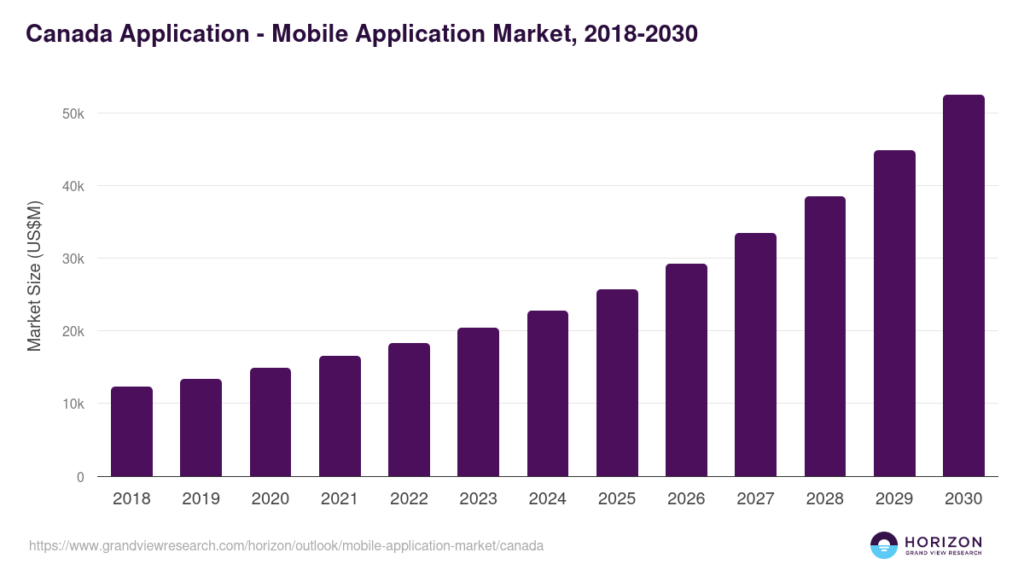
The Canadian mobile application market generated a revenue of USD 22,823.4 million in 2024 and is expected to reach USD 52,473.4 million by 2030. The following chart shows how the Canadian mobile app market has grown since 2018.

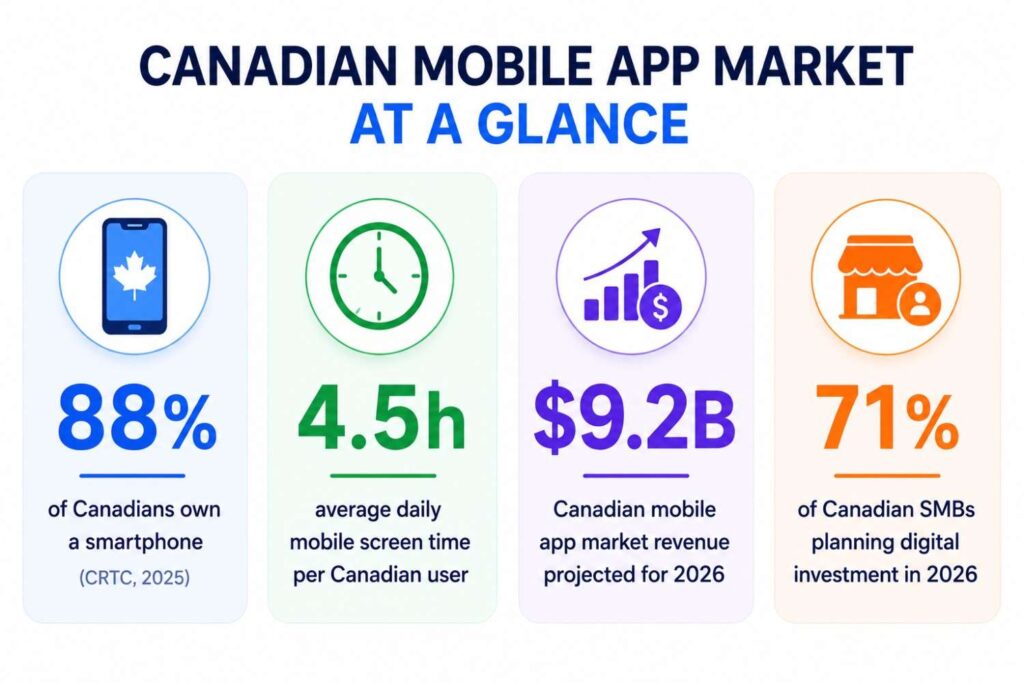
The app development market in Canada grows at a CAGR of 15.3% from 2025 to 2030, with users spending more than 4.5 hours on apps per day. These created the best opportunities for app developers Canada. But app development demands significant investment, and hence, each business’s first question is about the development cost. 

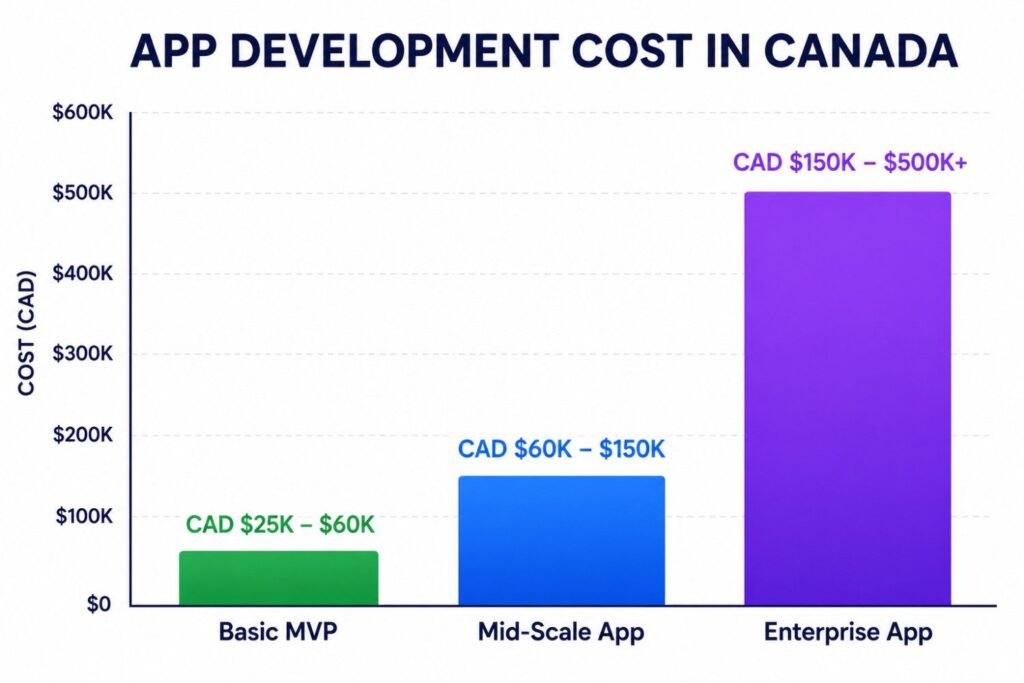
The answer is simple: the app development cost in Canada varies with several factors, including complexity, features & functions, and development time. But on average, we can classify the cost of the development as follows: 

Types of appsDevelopment Cost
Simple app with basic features $40,000 ($54,000 CAD) 
Complex app with advanced features $400,000 ($540,000 CAD) or more
Enterprise-grade or large-scale global brands$700,000 ($945,000 CAD) or more

Let’s break down the development cost in detail, along with its hidden expenses, optimization strategies, and actual insights, which help businesses to decide their budget effectively for their mobile app project.

80% of businesses are adopting mobile apps for their business strategy in 2026, and you are still thinking! Discuss your project idea more precisely with us and get a free development cost quote.

How to Calculate an Estimate App Development Cost

Basically, to estimate the development cost, you need to consider the app’s features, design complexity, and the type of platform you choose (iOS, Android, or cross-platform). The following is a basic formula to estimate the cost: 

Cost Estimate = Developer’s hourly rate * Estimated hours  

For example, if the Canadian professional you choose is charging $60 USD ($81.47 CAD) and they will need 445 hours to complete the work, then the estimated cost will be (60 * 445) 26,700 USD and $36,250.59 CAD.

The App Development Cost in Canada: A Comprehensive Table

Type of AppsInclusionsEstimated Cost (in USD) Estimated Cost (in CAD) 
Simple apps Minimal features, straightforward UI, and no backend database $40,000 to $75,000$54,000 to $101,250
Medium-complexity apps More features than simple apps, user accounts, basic backend integration, APIs, and interactive UI. $75,000 to $150,000$101,250 to $202,500
Advanced apps Extensive features, intricate backend architecture, multiple 3rd-party integrations, real-time data synchronization, custom animations, and advanced security measures. $150,000 to $400,000 or more $202,500 to $540,000 or more 
Enterprise-grade apps A sophisticated app includes a custom app design, huge data management features, and integration with existing legacy systems, and prioritizes robust security, scalability, and specific business logic. $400,000 to $945,000 or more $540,000 to $1,283,002.88 or more

Factors Affecting Mobile App Development Cost in Canada

1.Complexity of Design

A friendly app design is non-negotiable in 2026. The basic UI, having a simple/generic design, costs less, while the mobile app development company in Canada that offers custom animations and comprehensive UX costs you more. Hence, we can consider the basic UI costs you $5,000 to $15,000 USD ($6,750 to $20,250 CAD), and custom UI/UX will cost you approximately $15,000 to $50,000 USD ($20,250 to $67,500 CAD).

2.Backend Development 

Backend infrastructure, APIs, servers, and databases are important for any app. Simple apps have minimal backend work, while complex apps considering real-time data or AI demand robust systems, which cost you more. 

Backend Type Cost Range (USD) Cost Range (CAD) Capabilities 
Basic Backend $10,000 to $25,000$13,500 to $33,750 Simple database and basic APIs
Standard Backend $25,000 to $60,000$33,750 to $81,000 Complex database and multiple APIs
Enterprise Backend $60,000 to $150,000$81,000 to $202,500Microservices and high availability 

3.Complexity of Features 

Feature complexity is the most important cost driver for each app developers Canada. Every small feature, including user registration to real-time chat, requires separate UI/UX design, development, and testing, which increases the cost. The following is an estimated cost of app development based on features.

Feature Complexity Cost Range (USD) Cost Range (CAD) 
Basic features $2,000 to $8,000 $2,700 to $10,800 
Intermediate features$8,000 to $25,000 $10,800 to $33,750 
Advanced features $25,000 to $80,000 $33,750 to $108,000
Enterprise features $80,000 to $200,000$108,000 to $270,000 

4.3rd-party App Integration 

3rd-party app integration, including payment gateways like PayPal, Stripe, Google Pay, debit/credit card, etc., social media logins, or GPS integration, costs you more. These integrations need individual development and testing. 

The basic integration, like social media login, will cost you $2,000 to $10,000 ($2,700 to $13,500 CAD). While the advanced integration, like payment gateways and GPS, will cost you $10,000 to $30,000 ($13,500 to $40,500 CAD). 

5.Technological Trends 

Integrating cutting-edge technologies like AI, ML, IoT, GenAI, AR/VR, etc., is complex, and hence, the mobile app development company in Canada costs you more. According to the prediction of Gartner, 33% of enterprise software apps will include agentic AI by 2028, which shows the importance, growth, and demand of the cutting-edge technologies in mobile app development. 

Technology Type Cost Range (USD) Cost Range (CAD) Applications 
AI/ML Integration $15,000 to $50,000$20,250 to $67,500Chatbots, recommendations, and analytics
AR/VR Features $20,000 to $80,000 $27,000 to $108,000Virtual try-ons and immersive experience 
IoT Connectivity $10,000 to $40,000 $13,500 to $54,000 Smart device integration and sensors 
Blockchain Integrations $25,000 to $100,000$33,750 to $135,000Cryptocurrency and smart contracts 

6.Security Measures 

Security measures are the topmost priority for each app owner to prevent any unnecessary app vulnerabilities. Integrating data encryption techniques, secure APIs, and compliance with GDPR or PIPEDA increases the overall app development cost. 

Security Level Cost Range (USD) Cost Range (CAD) Features 
Basic security $5,000 to $12,000 $6,750 to $16,200SSL, basic encryption 
Standard security $12,000 to $25,000 $16,200 to $33,750 Two-factor auth and data encryption 
Advanced security $25,000 to $50,000 $33,750 to $67,500 Advanced encryption and compliance 

7.Platform Selection 

You have to choose between iOS, Android, or cross-platform development, and your choice affects the costs. The cross-platform frameworks like Flutter or React Native can reduce the app development cost by up to 30%, as per the generic studies. 

Platform Strategy Cost Range (USD) Cost Range (CAD) Market Reach 
iOS $40,000 to $150,000 $54,000 to $202,500 60% Canadian Market (approximately) 
Android $35,000 to $140,000 $47,250 to $189,000 40% Canadian Market (approximately)
Cross-platform $50,000 to $200,000 $67,500 to $270,000 100% market coverage 

8.Compliance Measures 

Each app needs to handle sensitive data like personal information, financial information, health-related data, and more, which is why it is essential to comply with regulatory standards like HIPAA, GDPR, and PIPEDA in Canada. Compliance integration, audits, and legal reviews increase the development cost. 

Compliance Type Cost Range (USD) Cost Range (CAD) Requirements 
Basic PIPEDA $3,000 to $8,000 $4,050 to $10,800Privacy policy and consent mechanisms 
Industry Compliance $8,000 to $20,000 $10,800 to $27,000 Healthcare and finance regulations 
Enterprise Compliance $20,000 to $40,000 $27,000 to $54,000SOC 2 and ISO 27001 certifications 

The Hidden Development Cost That You Must Consider

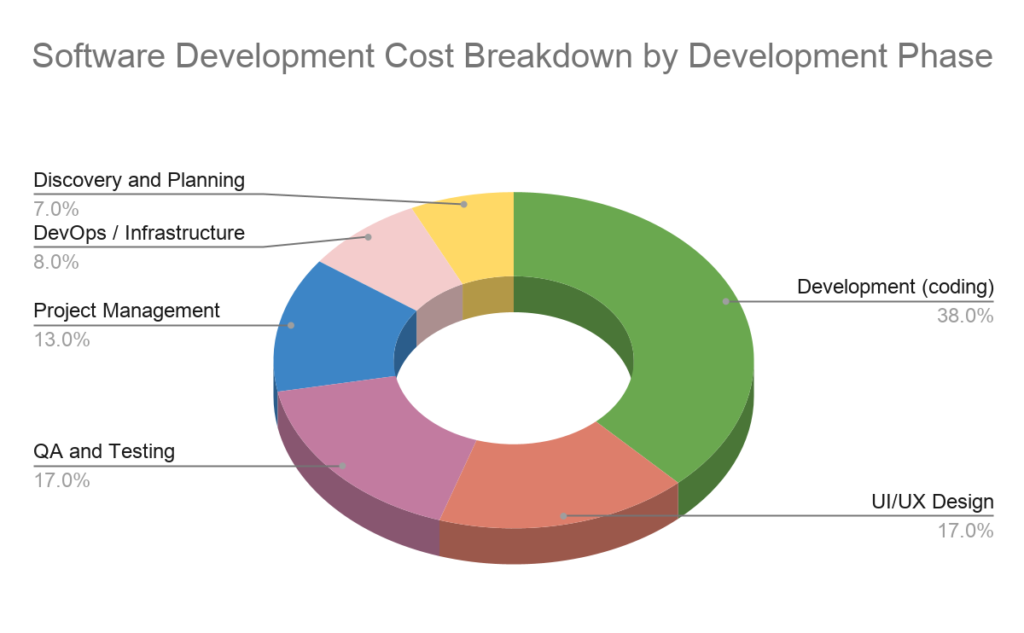
The following are some overlooked expenses that demand 20% to 30% of your initial investment. You must consider the following costs while preparing a budget for app development.

1.App Maintenance

Precisely, the app maintenance cost will be 15% to 20% of the initial development cost per annum, which includes

  • Bug fixes and minor updates: $500 to $1500 CAD per month
  • Feature additions: $2000 to $8000 CAD per feature 
  • OS compatibility updates: $3,000 to $10,000 CAD annually 
  • Security cost: $1,000 to $3,000 CAD quarterly 
  • Performance optimization: $2,000 to $5,000 CAD quarterly

2.App Hosting

The cost of cloud hosting varies based on user base and data requirements. As the app grows, hosting expenses scale accordingly, requiring careful planning for sustainable growth. 

  • Basic hosting (up to 10k users): $100 to $500 CAD per month 
  • Scalable hosting (10k to 100k users): $500 to $2,000 CAD per month 
  • Enterprise hosting (100k+ users): $2,000 to $10,000 CAD per month 
  • Content Delivery Network (CDN): $200 to $1,000 CAD per month 
  • Database hosting: $300 to $1,500 CAD per month

3.App Promotion and Marketing

To launch the app successfully, the mobile app development company needs marketing investment too to reach the targeted users. 

  • App Store Optimization (ASO): $2,000 to $5,000 CAD 
  • Digital marketing campaigns: $5,000 to $20,000 CAD per month 
  • Partnership with influencers (not compulsory, but beneficial): $3,000 to $15,000 CAD per campaign 
  • PR and media outreach: $2,000 to $8,000 CAD per month 
  • Social media marketing: $1,500 to $6,000 CAD per month 
  • Paid ads (Google/Facebook): $3,000 to $15,000 CAD per month

4.Legal and Licensing Fees 

Canadian businesses must consider various legal needs and licensing costs to ensure compliance and protect intellectual property. 

  • Privacy policy and terms of service: $1,500 to $5,000 CAD 
  • Trademark registration: $1,000 to $3,000 CAD 
  • App store fees: $135 CAD (Apple) + $35 CAD (Google) per annum 
  • PIPEDA compliance consulting: $3,000 to $10,000 CAD 
  • Software licensing: $500 to $2,000 CAD annually 
  • Legal review and contracts: $2,000 to $8,000 CAD

Ready to turn your app idea into a powerful digital product? Discuss your vision and plan the right development strategy with iQlance app experts.

Partner with iQlance – A Leading Mobile App Development Company in Canada

Estimating app development cost in Canada can seem challenging. From idea discussion to getting a fully functional, market-ready app, each step carries important decisions that impact the overall budget and quality of the app, too. 

However, partnering with iQlance Solutions, a leading mobile app development company in Canada, helps you to estimate step-by-step costs and hidden costs too, which helps you to manage your investment accordingly. 

As trusted app developers Canada, we understand the nuances of the Canadian market and the global tech environment, ensuring your app is not just built, but built for success and overall business growth. We have delivered 1000+ successful projects across various industries, including logistics and supply chain, ride-sharing, taxi-booking, education, healthcare, health & fitness, finance, and more. Our professional app developers guide you through every phase of development, from initial cost calculation to post-launch maintenance and more. 

Hence, don’t let the biggest question on the cost deter your vision, and let’s discuss how we bring your app idea to a fully functional mobile app, ensuring a seamless development journey and growth in business ROI.

FAQs

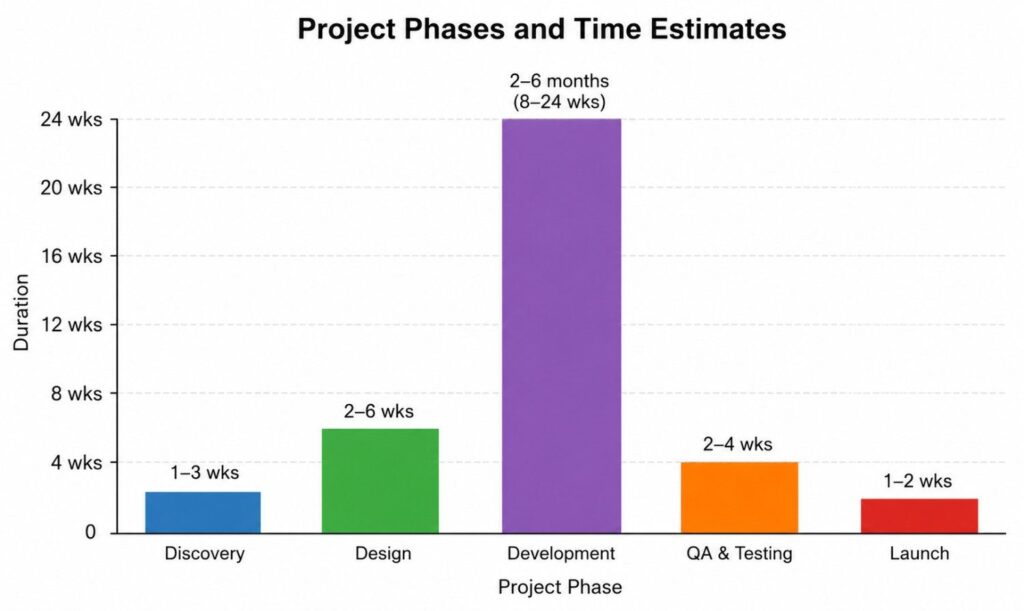
App development timelines vary on the basis of various factors, including the complexity of the app, features, and platform requirements. However, the basic app takes 4 to 6 months, the complex app takes 6 to 9 months or more, and the enterprise-grade app takes 6 to 12 months or more to develop. This timeline includes discovery, design, prototyping, development, testing, and deployment.

Start by reviewing the company’s portfolio, expertise, client testimonials, communication & transparency, and post-launch support. Check whether the team has experience with cutting-edge technologies or not. A trusted company should offer an end-to-end app development process along with transparency and a strategic app development roadmap to build scalable apps.

Begin with a well-defined project scope and prioritize important features. Launching a Minimum Viable Product (MVP) can help you test the market before investing in advanced features. Choose the right platform strategy, avoid unnecessary complexities, and working with an experienced development team can also help you manage the app development cost effectively.

Yes, we sign a non-disclosure agreement (NDA) before discussing or starting any projects. The NDA ensures your business idea, project details, and sensitive information remain confidential and protected throughout the development process.

Yes, we integrate cutting-edge technologies, including AI, into your existing mobile apps. AI features like smart recommendations, chatbots, predictive analytics, and automation can improve user experience, improve engagement, and add advanced capabilities to your current app without rebuilding it from scratch.

Why Hire App Developers in Toronto for Your Business?

Mobile apps were a nice-to-have once, but recently, they’ve become a must-have business asset. Every niche, including retail, healthcare, logistics, and financial companies across Canada, is shifting towards mobile technology that improves customer engagement, streamlines operations, and gives them opportunities to create fresh revenue channels.

This might seem extreme, but as per the studies, 31 million smartphone users are spending more than 4.5 hours daily on mobile apps. But these numbers alone are saying one should not neglect the mobile app. However, the CEOs of the Canadian companies are questioning how to strategically develop an app and how to find the right app development Toronto partner. 

The Canadian mobile app market is generating over $3 billion in annual revenue every year as businesses are rapidly adopting digital solutions. These trends are pushing businesses, regardless of size, to explore app development for small business and enterprise solutions that deliver convenience and accessibility to their customers.

However, building a successful app requires the right expertise. This is why many organizations prefer working with experienced app developers Toronto businesses trust, ensuring their mobile solutions are scalable, secure, and aligned with market expectations.

12 Reasons To Hire App Developers Toronto

1.Access to Highly Skilled Developers 

Canada is one of the best places for the world’s most talented software engineers and mobile developers. The country is offering training to thousands of tech graduates every year from well-known universities and technical industries. The professionals working in Canadian development companies are highly trained in cutting-edge technologies, including: 

This technical expertise ensures that businesses receive high-quality native apps that are scalable, reliable, and future-ready.

2.Strong Technology Ecosystem 

Canada has a powerful technology ecosystem supported by government initiatives, innovation hubs, and venture capital investments. Cities like Toronto, Vancouver, and Montreal have rapidly grown into major global technology centers. This ecosystem encourages innovation, collaboration, and continuous improvement. As a result, the professionals in Toronto stay updated with emerging technologies and development frameworks, helping businesses build cutting-edge apps that meet growing user expectations. 

3.High Development Standards and Quality Assurance 

App quality is one of the biggest advantages of hiring Canadian developers. Most app development companies in Canada follow structured development methodologies such as Agile, Scrum, or DevOps. These processes ensure that: 

  • Projects remain transparent 
  • Development cycles are efficient 
  • Regular testing improves quality 
  • Bugs are minimized before launch 

This commitment to quality significantly reduces project risks and helps businesses deliver reliable mobile applications to their users. 

4.Expertise Across Multiple Industries 

Another major advantage of working with the Canadian developers is their experience across diverse industries. Canadian companies have worked with businesses in sectors such as logistics, ride-sharing, taxi booking, healthcare, education, health and fitness, real estate, and more.

Because of this cross-industry experience, developers can quickly understand business needs and build customized solutions that address real operational challenges. 

5.Cost-Effective Development Without Compromising Quality

While Canada offers top-tier development talent, the overall cost of hiring app developers Toronto is often more reasonable compared to developers in certain high-cost tech hubs. Businesses benefit from: 

  • Transparent pricing models 
  • Efficient development processes 
  • Reduced project delays 
  • High-quality output 

6.Strong Focus on Innovation

Canadian technology companies are known for adopting innovation. Many companies actively experiment with emerging technologies to build advanced digital solutions. These innovations include AI-powered apps, ML integrations, blockchain-based applications, augmented reality experiences, and IoT-connected systems. This approach helps businesses stay ahead of competitors and build apps that deliver unique user experiences.  

7.Reliable Communication and Collaboration

Communication plays a critical role in the success of any development project. Canadian development teams are known for their professional communication style and transparent collaboration.

Businesses working with app development Toronto teams often experience the following:

  • Clear project documentation
  • Regular progress updates
  • Structured development sprints
  • Collaborative feedback sessions

This communication culture ensures that projects remain aligned with business goals from the initial concept to the final launch.

8.Strong Data Security and Compliance

Security has become one of the most critical concerns for modern businesses, especially when mobile applications handle sensitive customer data.

Canada has strong data protection laws and regulatory frameworks that encourage companies to follow strict security practices. Most app development companies implement advanced security measures, such as data encryption, secure authentication systems, privacy-focused architecture, and compliance with international standards. 

For businesses handling customer data, financial information, or healthcare records, this security focus provides an additional layer of trust.

9.Experience with Global Clients

Canadian app development firms frequently work with international businesses across North America, Europe, and Asia. This global exposure gives professionals a strong understanding of international markets and diverse customer expectations.

Because of this experience, developers can:

  • Design apps for global audiences
  • Build a scalable architecture
  • Integrate multilingual features
  • Ensure global performance optimization

This makes Canada an ideal destination for businesses planning to expand their digital products worldwide.

10.Agile Development for Faster Time-to-Market

Speed is a critical factor in today’s competitive digital environment. Businesses cannot afford long development cycles when launching new applications.

Most app development companies in Canada use agile development methodologies that break projects into smaller, manageable iterations.

Benefits of agile development include:

  • Faster feature releases
  • Continuous improvements
  • Early detection of issues
  • Flexibility to adapt to new requirements

This approach helps businesses launch applications faster while continuously improving performance and features.

11.Long-Term Support and Maintenance

Launching a mobile application is only the first step. Continuous updates, bug fixes, and performance improvements are essential to maintain user satisfaction.

Reliable app development companies in Canada provide long-term support services, including app updates, security patches, performance optimization, feature enhancements, and compatibility updates for new devices

This ongoing support ensures that applications remain functional, secure, and competitive in the growing mobile ecosystem.

12.Perfect Partner for Small Businesses and Startups

Startups and small businesses often face unique challenges such as limited budgets, evolving ideas, and rapid market changes.

Canadian app development for small business services is specifically designed to help growing companies launch efficient applications without high costs.

Experienced app developers Toronto can help startups by refining app ideas, creating MVPs (Minimum Viable Products), providing scalable architecture, and offering flexible development models. This approach allows small businesses to test their ideas in the market quickly while keeping development budgets under control.

Why Local Expertise Matters for Canadian Businesses

Working with local developers offers various strategic advantages for businesses in Canada.

First, local developers understand the country’s regulatory environment, including privacy laws and data protection standards. This ensures that applications remain compliant with relevant regulations.

Second, local collaboration allows businesses to build stronger relationships with their development teams. Face-to-face meetings, workshops, and strategy sessions become easier when teams operate within the same region.

Finally, local developers provide more reliable long-term support. As businesses grow and expand, they need partners who can continuously improve and scale their applications.

Why Businesses Choose iQlance Solutions for App Development in Toronto

When businesses look for reliable app development companies, they want a partner that understands both technology and business strategy. This is where iQlance Solutions stands out. With years of experience in mobile app development, iQlance Solutions has helped startups, small businesses, and enterprises transform their ideas into powerful digital products.

1.Local Presence in Canada

Having a strong presence in Canada allows iQlance to work closely with clients and understand their specific business needs. This local accessibility helps build trust and ensures smoother collaboration throughout the project lifecycle.

2.Experienced Mobile App Developers

The company’s development team includes skilled professionals who specialize in iOS, Android, and cross-platform app development. Their expertise ensures that businesses receive high-quality applications tailored to their goals.

3.Custom Development Approach

Every business is unique, and so are its digital requirements. Instead of offering one-size-fits-all solutions, iQlance focuses on building custom applications designed to address specific business challenges.

4.Agile and Transparent Development

iQlance follows an Agile development methodology, allowing clients to stay involved throughout the development process. Regular updates and clear communication help ensure that projects progress smoothly and meet expectations.

Conclusion

Mobile technology continues to reshape how businesses operate and interact with their customers. Companies that invest in well-designed mobile applications can improve customer engagement, enhance operational efficiency, and get new revenue opportunities.

However, building a successful app requires expertise, strategic planning, and a reliable development partner. By hiring experienced app developers Toronto businesses trust, organizations can ensure their applications are secure, scalable, and aligned with market expectations.

If you are planning to develop a mobile application for your business, working with a trusted partner like iQlance Solutions can help transform your vision into a powerful digital product.

FAQs

The cost of mobile app development in Toronto depends on several factors, including the app’s complexity, features, design requirements, and development platform. Simple applications may cost less, while complex enterprise solutions require a larger investment.

Development timelines vary depending on the project scope. A basic app may take a few months, while feature-rich applications can take six months or longer to develop.

Yes. Many development companies offer scalable solutions designed specifically for small businesses. These solutions allow companies to start with essential features and expand the application over time.

Most professional development companies offer ongoing maintenance and support services. These services include bug fixes, updates, performance optimization, and feature improvements.

To choose the right developers, businesses should evaluate the company’s portfolio, technical expertise, client reviews, communication practices, and post-launch support services. Working with an experienced and transparent team ensures a smoother development process.

MVP App Development in Toronto: A Comprehensive Guide for Startups

Let me guess! You are planning to build apps like Facebook, TikTok, Tinder, Uber, Spotify, and more, right? And you are planning to hire a mobile app development partner in Toronto for the same. But wait, have you checked their history? I agree, they have multifunctional apps with intuitive features and app designs to give an engaging user experience. However, it was not always the scenario; they started with developing an MVP or a minimum viable product.

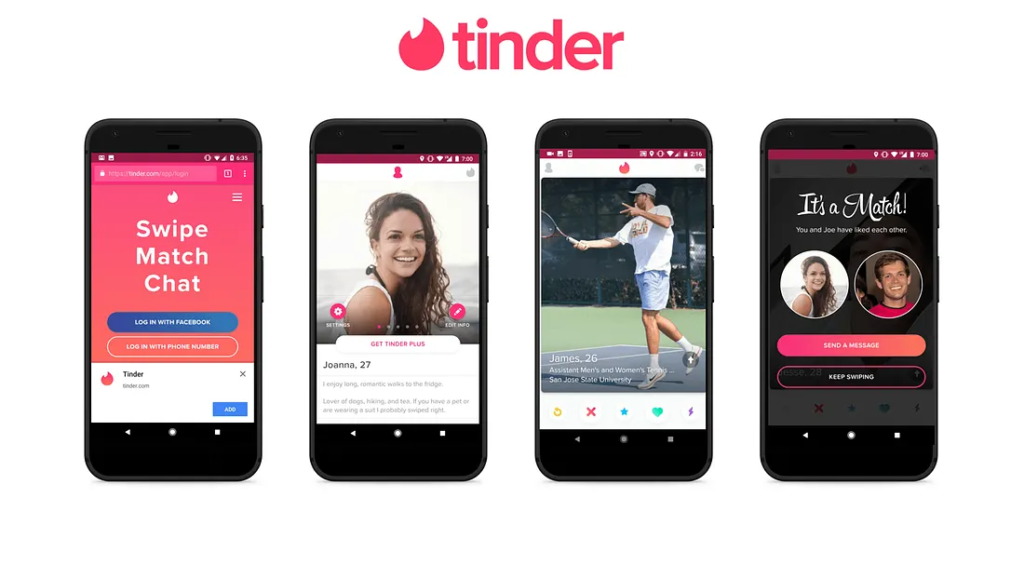
Let’s take an example of Gen Z and millennials’ favorite app, Tinder. The ‘Match Group’ first introduced Tinder as an MVP in 2012. Initially, there were no swipe functions; instead, they gave ‘♥️’ for like and ‘❌’ for dislike. They also introduced gamified success with the “It’s a Match” screen, especially designed to trigger a winning feeling! Early profiles focused heavily on photos, name, and age, reducing the “job application” feel of traditional dating sites compared to the fully functional platform we use today.

Through MVP app development, Tinder has gradually grown over time and extended its reach by introducing more features and adding more functionalities. They have made $1.94 billion in revenue in 2024, a 1.1% increase on the year prior. It had 60 million monthly active users and 9.6 million subscribers in 2024. And in 2026, the app had 75 million monthly active users (MAU) globally.

These data clearly say that building a minimum viable product (MVP) is a way to test the success of a business idea at a minimal cost. This incremental approach of starting from minimal features and scaling over time helps you minimize an initial investment as well as allow for flexible adaptation to users. 

In this blog, we will discuss MVP development for startups, its benefits, how to develop it, cost, and many more things that will help you to know this approach inside out.

What is an MVP in a startup?

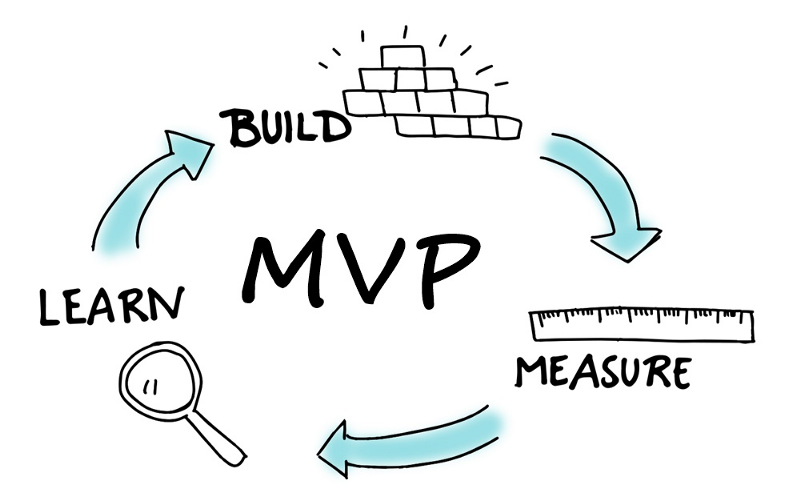
In simple words, MVP is the most basic version of a product with just enough features to be usable by early users and to validate the business idea. The following image shows what an MVP actually is for startups. 

Now the question is, why should startups follow the MVP approach? MVP enables you to test your assumptions, understand your audience’s actual needs, and make data-driven improvements, all without committing substantial time or resources upfront. This approach helps reduce risk and ensures that the product you are building is agile with market demand.

Why Do Startups Choose MVP Development the Most?

The following are some important reasons why startups, SMBs, and even enterprises must invest in MVPs and consult the best app development company Toronto

1. Market Validation 

Startups often operate with uncertainty about user needs and preferences. MVP helps allow them to test their core idea with actual users and validate market demand before developing a fully functional app. It ensures that the product aligns with what users actually want. 

2. Risk Mitigation 

Launching a fully functional app without testing can lead to significant financial losses if it fails to resonate with the targeted audience. The MVP development approach minimizes these risks by focusing on important features and gathering feedback early on, helping with adjustments before investments are made. 

3. Efficient Resource Allocation 

Startups can avoid wasting time and money on unnecessary features by developing an MVP. The MVP approach ensures that resources are directed toward what truly matters to the target audience, optimizing development processes and reducing waste. 

4. Competitive Advantage 

Custom MVP development services allow startups to enter the market quickly, potentially outpacing competitors with similar ideas. The early-mover advantage can be important for establishing market presence and brand recognition. 

5. Investor Attraction 

A functional MVP demonstrates progress and viability, making it easier for startups to secure funding and gain investor trust. Investors are more likely to support projects that show tangible results and a clear growth path.

How to Build an MVP?

The following is the process that the leading mobile app development company Canada follows to build a successful MVP. 

1. Conduct Market Research 

The first step of any mobile app development is conducting thorough market research. It will help you understand the growing needs of your target market and what they are looking for in a product or service. Many platforms conduct paid surveys and can help target the right respondents for your MVP in business. 

2. Identify Your Target Market 

After completing market research, the next step is to identify your target market and user persona. It includes identifying the demographics of your targeted niche by answering a few questions, like 

  • Who will be our target user? 
  • What do they actually need? 
  • Why would they use our app?
  • What benefits will they get by using our app? And more. 

After figuring out all the answers, you can easily determine who will use your MVP and what they are expecting from the particular app. 

3. Outline Key MVP Features 

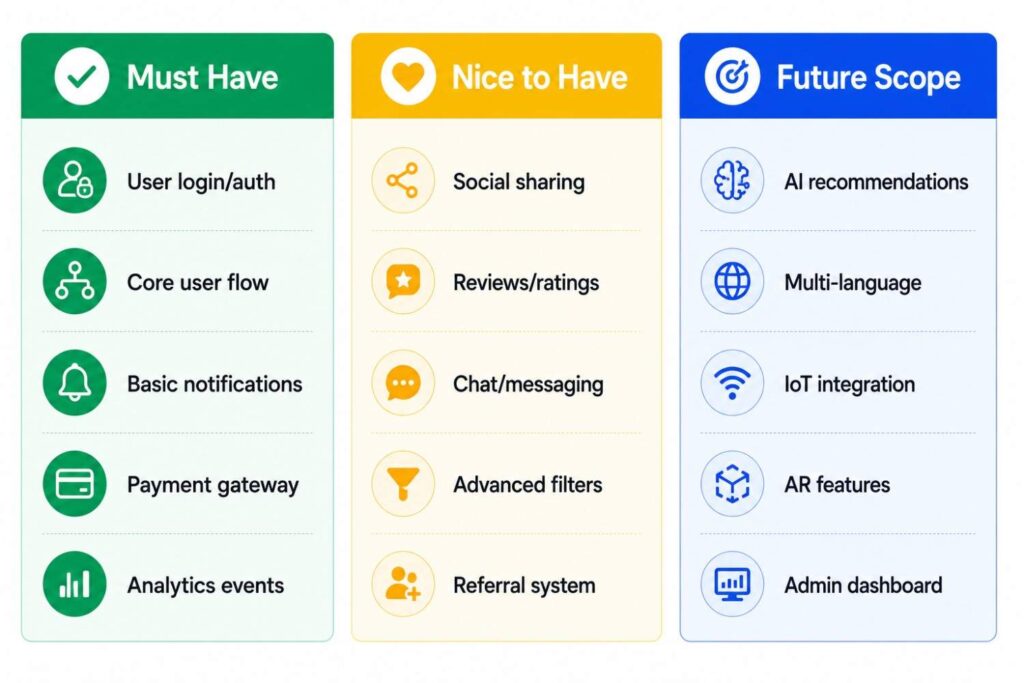
Now you have a complete idea of your target market and their needs, right? So, the next step is to outline the key features of your app. It includes identifying the core functionalities of your MVP solution and services. “Less is more” is what you need to always remember while choosing the MVP approach. Hence, you should focus only on the important features that address the needs of your targeted niche. 

4. Build and Launch MVP 

The feature list is ready! Now you can go ahead and build and launch an MVP. You can partner with the leading app development company in Toronto, like iQlance Solutions, to build a user-friendly product and make it available to the target market. This step also involves promoting your minimum viable product and getting user feedback for adding value to your app. The feedback you will receive will be invaluable, as it will help determine what features to add or remove and how to improve your app. 

5. Analyze the Feedback 

After launching an MVP, it’s time to analyze users’ feedback and figure out what is working and what is not. Remember, a minimum viable product will have flaws and areas of improvement. However, the feedback and data you receive will help refine your app and eventually develop a fully functional version for the end users.

How Much Does It Cost To Build an MVP in Canada

1. Cost Breakdown by the Complexity of MVP

Type of MVPApproximate cost (in CAD) Tentative Time Taken Inclusion 
Simple/Basic MVP$5,000 to $50,0003 to 5 months Core features, simple UI, limited, and no third-party integrations.
Mid-Level/Standard MVP$15,000 to $100,0004 to 9 months Multiple workflows, dashboards, and moderate integrations.
Advanced/Enterprise MVP$50,000 to $300,000 or more8 to 12 months or more High security, AI, or complex, real-time features.

2. Cost by Team Structure

Team Structure Approximate cost (in CAD) 
Freelancers$30,000 (best for tight budgets)
Offshore/Outsourcing$11,999 to $36,000
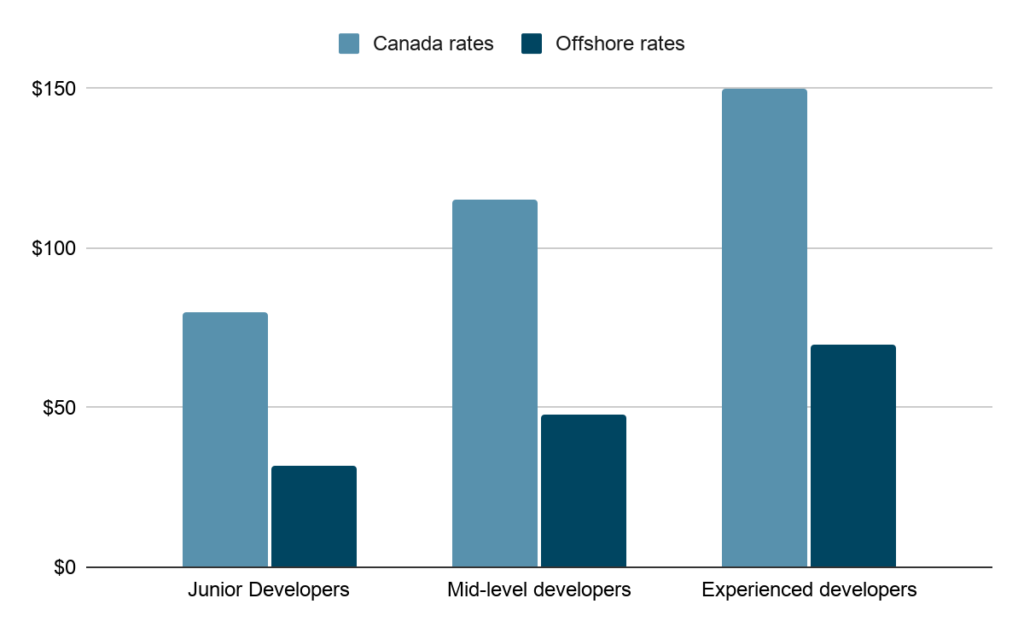
Local Canadian Agency$70,000 to $180,000 or more

A Quick View on Factors Affecting MVP Cost 

Factors Details/Approximate cost (in CAD)
Feature ComplexityMore complex features will cost you more. 
Design RequirementsTemplate-based design: $3,000 to $8,000 (uses UI kits like Material Design)
Custom design: $8,000 to $25,000 (unique brand identity, custom components)
Premium design: $25,000 to $50,000 or more (animation, micro-interactions, illustration)
Platform ChoiceSingle platform: Launch on iOS or Android only ($15,000 to $40,000)
Cross-platform: React Native or Flutter for both iOS/Android from one codebase ($25,000 to $70,000)
Progressive Web App: Works on all devices through browsers ($20,000 to $50,000)
All three separately: iOS, Android, and web with native code ($60,000 to $180,000)
Integrations and 3rd-party ServicesStripe payments: +$2,000 to $5,000 (setup, testing, handling webhooks)
Google Maps: +$1,500 to $4,000 (integration, customization)
Push notifications: +$1,000 to $3,000 (OneSignal, Firebase setup)
Social login: +$1,500 to $3,000 per platform (OAuth, token management)
Email service: +$1,000 to $2,500 (SendGrid, templates)
Analytics: +$1,000 to $3,000 (Mixpanel, Amplitude setup)
Backend ComplexitySimple backend: Firebase/Supabase ($5,000 to $15,000) – CRUD operations, basic auth
Custom API: Node.js, Python, or Rails ($15,000 to $40,000) – Business logic, integrations
Complex backend: Microservices, real-time processing ($40,000 to $100,000+) – Scale, performance
AI/ML components: Additional $20,000 to $80,000 depending on complexity
Team Structure and LocationIn-house team: $25,000 or more per month
Local agency: $50,000 to $150,000
Freelancers: $50 to $150/hour
Post-Launch CostsHosting: $50 to $500/month, depending on users and data
Third-party services: $100 to $500/month (Stripe, SendGrid, AWS, etc.)
Maintenance: $2,000 to $5,000/month for bug fixes and updates
Iteration: $10,000 to $30,000 over 6 months based on user feedback

The Different Types of MVPs

The following are different types of MVPs that you should know as a startup. The best app development company Toronto guides you with all the MVP models and helps you to choose the best fit for your app idea.

1. Concierge MVP 

A concierge MVP flips the idea of automation on its head. Instead of building a fully functional product, you manually deliver the service to early customers. This approach includes: 

  • Direct interaction with users: Spend time understanding individual needs and customizing your service accordingly. 
  • Personalized experiences: Offer a high level of customization to showcase your product’s value. 

2. Wizard of Oz MVP 

You can create the illusion of a complete product with the Wizard of Oz MVP approach. But behind the scenes, everything is operated manually. The following is how this approach works: 

  • Simulated functionality: Design a user-facing interface that looks fully operational. 
  • Manual backend operations: Manually handle all the processes, including data collection and customer support. 

3. Single-feature MVP 

A single-feature MVP focuses on delivering one core functionality of the product that addresses a specific user problem. Instead of building a product with a suite of features, this approach prioritizes simplicity and direct value. 

  • Single focus: The MVP concentrates on one feature that solves a critical user pain point or highlights the product’s unique selling proposition. 
  • Ease of development: With fewer features, the product can be developed quickly and with minimal resources. 
  • User feedback: The simplicity of a single-feature MVP allows users to focus on evaluating the primary feature, making feedback more targeted and actionable. 

4. Piecemeal MVP 

A piecemeal MVP leverages existing tools, technologies, and services to create a functional product prototype without starting the development process from scratch. This type of MVP combines off-the-shelf components to deliver a coherent experience to users. 

  • Use of pre-built tools: This approach involves integrating various platforms and 3rd-party APIs, such as WordPress, Google Forms, or other software solutions, to provide necessary functionalities without extensive coding. This allows startups to quickly assemble a product using readily available resources. 
  • Core Functionality First: The primary focus is on solving the main user problem. The MVP should demonstrate the product’s potential value by showcasing its essential features without unnecessary complexity. 

5. High-fidelity MVP 

A high-fidelity MVP app development is a more polished, functional version of your product. It closely resembles the final product, offering a better UX, but it needs more resources to develop. 

  • Advanced prototyping: High-fidelity MVPs are more polished and closely resemble the final product. They include a higher level of design and functionality, allowing for a more realistic UX. 
  • Comprehensive features: These MVPs often incorporate multiple features, providing a better representation of how the product will function in its final form. 

6. Low-fidelity MVP 

A low-fidelity MVP is a basic and cost-effective prototype designed to test the core concept or validate the initial idea quickly. 

  • Simpler design: Focused on essential features and minimal design. 
  • Quick development: Needs fewer resources and can be built in a shorter timeframe. 

7. Landing page MVP

A landing page MVP is one of the simplest and most effective ways to validate a product idea before diving into the full-scale development process. It involves creating a single webpage designed to: 

  • Introduce your product or service: Clearly explain what your product is about, the problem it solves, and the benefits it offers. Use simple, concise language to grab attention quickly. 
  • Include engaging visuals: Use images, graphics, or videos to make the page visually appealing and help users better understand the concept. Visuals are especially important for demonstrating the product’s value. 
  • Provide calls to action (CTAs): Add sign-up forms, learn more buttons, or pre-order options to measure user interest. CTAs help collect valuable data, like the number of visitors who are willing to engage or leave their email address.

Challenges Startups Face While Developing MVP

1. Defining the Right Scope: Startups often struggle to identify which features should be included in the MVP and which should be left for future updates. Choosing the wrong scope can either make the product too basic or unnecessarily complex.

2. Budget and Resource Constraints: Limited funding and smaller teams can make it difficult for startups to manage development costs, hire skilled developers, and maintain consistent progress during the MVP development process.

3. Balancing Speed with Quality: Since MVPs are meant to launch quickly, many startups face the challenge of maintaining app quality, performance, and stability while trying to reduce development time.

4. Gathering Accurate User Feedback: Collecting meaningful feedback from early adopters can be difficult, as users may provide unclear suggestions or feedback that does not align with the product’s core objective.

5. Overcoming Technical Limitations: Many startups lack technical expertise when choosing the right technology stack, integrations, or architecture, which can affect the scalability and performance of the MVP.

Build a Cost-Effective MVP With iQlance Solutions

Turning a great idea into a successful product requires the right strategy, technology, and development partner. This is where iQlance Solutions comes in. As a trusted mobile app development company Canada, we help startups and growing businesses transform their innovative ideas into scalable digital products through efficient MVP app development services.

Our team focuses on building a functional MVP that includes only the most important features needed to validate your business idea in the real market. Instead of spending months and a large budget on a fully developed product, we help you launch quickly with a streamlined solution that gathers actual user feedback and market insights.

We follow a structured development approach that begins with understanding your business objectives, target audience, and product vision. Our experienced developers, designers, and strategists work collaboratively to identify the core functionalities required for your MVP. This ensures that your product solves a real problem while maintaining simplicity, usability, and performance.

As a reliable app development company Toronto, we also prioritize scalable architecture and future-ready technology. This means the MVP we build today can easily grow into a fully functional application as your business grows and new user requirements emerge. Our team carefully selects the right technology stack, development framework, and integrations to ensure flexibility, security, and long-term sustainability.

Another key advantage of partnering with iQlance Solutions is our focus on cost optimization. We help startups avoid unnecessary development expenses by prioritizing essential features, adopting agile methodologies, and delivering iterative updates based on user feedback. This approach not only reduces the initial investment but also helps businesses make data-driven improvements over time.

From idea validation and UI/UX design to development, testing, and deployment, iQlance Solutions provides end-to-end mobile app development services custom to the unique needs of startups and enterprises. With a proven track record of delivering high-quality applications across various industries, we support businesses to launch faster, reduce risk, and achieve sustainable growth in the competitive digital marketplace.
If you are planning to launch a startup or test a new product idea, partnering with an experienced mobile app development company Canada like iQlance Solutions can help you build a reliable and cost-effective MVP that sets the foundation for long-term success.

FAQs

The cost of MVP development in Canada varies depending on the feature complexity, UI/UX design, platform choice (iOS, Android, or cross-platform), backend infrastructure, and third-party integrations. But precisely, you can consider the app development cost between CAD $5,000 and $300,000 or more.

Again, the development timeline highly depends on the feature complexity, UI/UX design, backend infrastructure, and more. But typically, the MVP development will take 3 to 9 months or more.

An MVP implementation strategy focuses on launching a product with the minimum set of features required to solve a core user problem. The process usually includes market research, defining target users, prioritizing core features, developing the MVP, launching it to early adopters, and collecting user feedback. Based on actual user insights, the product is gradually improved with additional features and improvements through iterative updates.

Yes, most professional development companies, like ours, sign a non-disclosure agreement (NDA) before starting the project. The NDA ensures that your app idea, business model, technical information, and other confidential details remain fully protected throughout the mobile app development process.

No, an MVP, prototype, and POC are all different. A prototype is an early visual representation used to demonstrate the design and user flow of the product. A proof of concept (POC) is created to test whether a particular idea or technology is technically feasible. While an MVP is a functional product with essential features that can be launched to real users to validate the business idea and gather feedback.