How to Validate Your App Idea Before Writing A Single Line of Code
Introduction
The world’s mobile users spent 5.3 trillion hours on mobile apps in 2025. The year also saw almost 150 billion app downloads. These numbers show how big the mobile app market is! But a big market isn’t a guarantee of success. An App should solve a real problem! It also needs to be useful for its intended users.
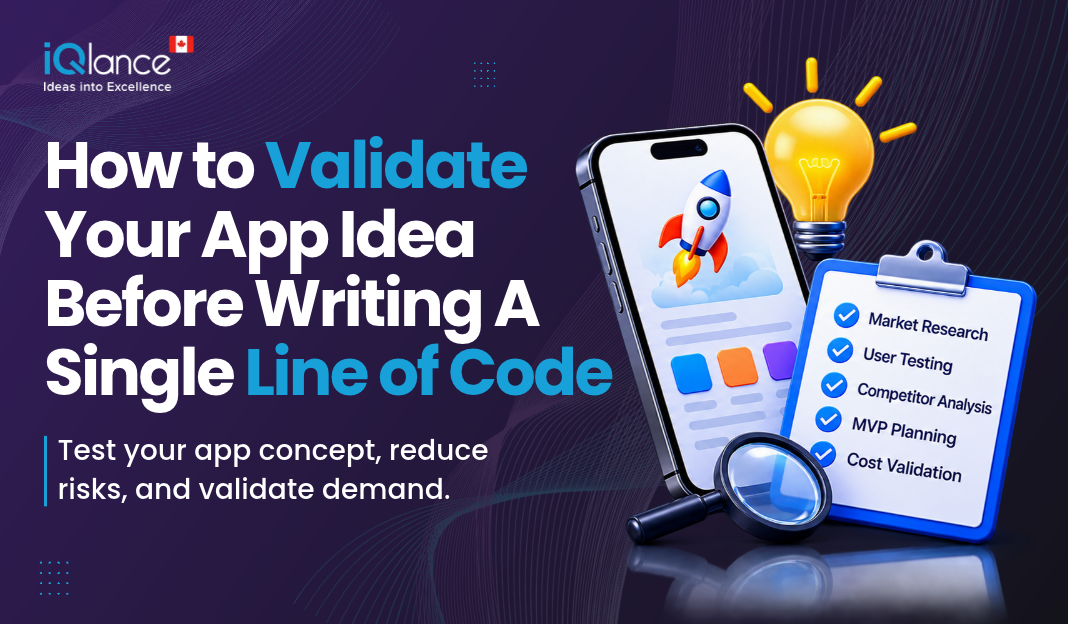
That’s why validating an app idea before development is crucial. It helps businesses understand their users, learn about competitors, test demand, and define the right MVP. The goal is simple. Test the opportunity before spending time and money on development. This guide describes how to test your app concept before coding.
How to test an app concept?
Test an app concept by addressing the problem you’re trying to solve. Identify the population that has that problem. Do market research and review solutions. Then, talk to prospective users. Test demand on a landing page or through a pre-sale campaign. Build a working prototype to test the user journey.
Then, validate the business model. Explain what is meant by “MVP” and discuss the technical standards. Lastly, before embarking on a full-scale venture into mobile application development, estimate the costs associated with development.
What Is App Idea Validation?
App idea validation is used to ascertain the viability of an app concept for a particular target audience.
It can help answer three key questions.
- Desirability: Are people really in need of the solution?
- Feasibility: Is the product feasible using the technology, resources and budget available?
- Viability: Is a business model viable?
An app may be successful in one market, and not successful in another. A simple idea could be a solution to a problem that is unimportant to users. A good concept can also need more capital than the business can provide.
Validation is a way to detect these problems at an early stage.
Steps to Validate Your App Idea Before Development
Before building an app, you need to know if your idea is worth pursuing. These steps will help you understand user needs, market demand, and business potential.
Step-1 Start With the Problem, Not the App
Most app ideas start with the features. This is usually the beginning that’s missing. For instance, if you ask for an app for fitness, you’re not really stating a problem. It’s a product category description. It would be better to have a more specific idea. “Simple workouts are not something that busy professionals can find to incorporate into their daily routine.” Now there is a problem to investigate. Know who will have the problem before defining features.
Determine the frequency of its occurrence. Educate users about solutions to it. Explain why the existing solution is challenging. A problem that is clearly defined provides your product with a more solid base.
Step-2 Identify your Target Audience.
An all-people app can be hard to please. Identify a target audience. Think about their age, profession, buying habits, problems and their solutions now. For instance, the target audience for “people who want to exercise” is rather wide. “Busy Toronto people looking for quick home workouts” is more specific.
It’s easier to validate a focused audience. It also supports product design, marketing, pricing and MVP development.
Step-3 Research the Market
Market research provides you with a more general perspective of the opportunity. First, examine the existing discussions on the problem. Search interest can be displayed using Google Trends. App stores can show what is already available and user comments.
You can get market information from industry reports. Real user conversations are exposed in social media and online communities.
Other competitor websites and industry forums are good resources, too. Keep an eye out for common gripes. Listen to questions, frustrations, and unmet needs. Such patterns can indicate the places where the current solutions are not effective. Research is not for the purpose of proving that your idea is correct. It’s to find out if this chance is worth it or not.
Step-4 Analyze Your Competitors
Competition can be a positive indicator. Typically demonstrates that people already invest time or money in trying to address the challenges.
Learn about direct and indirect competitors.
- Direct competitor: They have a similar solution, targeting a similar audience. Check their features, pricing, experience, ratings, reviews, onboarding, and subscription.
- Indirect competitors are those who provide a similar service, but do so through different means. Users can use spreadsheets, email, telephone, manual processes or other software.
You need to have a compelling reason to make the switch.
Don’t clone other products. Identify market opportunities. Research users’ preferences and dislikes regarding the existing solutions.
Step-5 Interview Potential Users.
Talk with individuals in the target audience. Don’t just depend on friends and family. Their words of encouragement can be ears tuned to what they want to hear, but not what they really want or need.
Data obtained through user interviews can provide data that market research cannot.
Inquire about authentic experiences.
- When was the last time you had this issue?
- What do you do about it now?
- What are your problems with your current solution?
- What is the frequency of the problem?
- Are you paying an expense now to fix it?
- What other solutions would you prefer to switch to?
Focus on behaviour rather than opinions.
The actual behaviours of users are often more valuable than what they think they might do.
Avoid pitching your idea during the interview. Your objective is to gain knowledge.
Step-6 Test Demand Before Building the App
An application is not required for testing demand. A simple landing page can provide information on the problem and proposed solution. It can also emphasize the key features and target audience. Include an obvious call to action. Users can sign up for a waitlist, request early access, book a consultation, or request a demo.
Ignore traffic on the website as a measure of demand. Sign-up and demo requests are more convincing evidence. Pre-orders and the eagerness to pay can give even better indications. The important point is to measure user behaviour.
Step-7 Create a Clickable Prototype
A clickable prototype will allow you to test your user experience before development. You don’t have to prototype each screen. Stick to the key user flow. This can involve signing up, searching, selecting a service, selecting the provider’s profile, selecting dates and time, and confirming a booking appointment. Present the prototype to other users.
Watch their reactions to it. Search for confusing screens and unnecessary steps. Find out what missing information there is and usability issues. Address these problems prior to development. A prototype can save time because it is easier to make the changes before the product is built.
Step-8 Check the Business Model (BM).
Product validation is more than just user interest.
A business model which can support that product is also required.
Subscription, one-time payment, commission, freemium, in-app purchase, ad, licensing and enterprise plans are some common models.
Understand the current solution that users pay for to solve the problem.
Then ask yourself if the price you come up with is fair.
In the case that the users desire the solution but are not willing to pay enough to support the business, something may have to change. May have to tweak the price, target customer, value proposition, or business model.
Step-9 Define Your MVP
The MVP must have the least number of features required to address the core problem. Avoid testing all features in the initial release. For instance, the basic features of a food delivery MVP could encompass customer enrollment, restaurant listings, menu navigation, cart management, checkout, order tracking, and fundamental notifications. Enhanced features can be added later. Ask one question for each proposed feature:
Does it enable the user to execute the basic task?
If the answer is yes, consider moving the feature to a later release. A focused MVP minimizes the initial complexity. It also enables businesses to gain insights from actual users more quickly.
An experienced MVP app development company can help you identify the right features for the first release.
Step-10 Check Technical Feasibility
Assess technical feasibility before development. Consider the platforms and technology needed. Discuss backend architecture and third-party services.
You may need to assess:
- iOS and Android
- Backend architecture
- APIs
- Payment gateways
- Maps and location services.
- Push notifications
- Authentication
- Cloud storage
- Security
- AI/Machine Learning
- Third-party integrations
- Data privacy
- Industry compliance
A technical evaluation can tell you up front what is complex.
It can also help ensure that any potential technical problems will not impact the development budget or timeline.
Step-11 Estimate Your App Development Cost
The mobile app development cost depends on the scope and technical complexity of the product. Several factors influence the budget. This includes the number of platforms, UI/UX complexity, features, backend requirements, integrations, security, custom functionality and testing, as well as maintenance.
The cost of an MVP tends to be less than that of a large marketplace or enterprise app. Businesses researching mobile app development cost in Canada should define the scope first.
Estimates are easier to compare if there is a clear scope.
How to validate an app idea for Canadian Businesses?
Canadian technology and startup ecosystem is robust. Developers, tech partners, investors and a range of customer markets can all be used to the benefit of the business. But good technical resources are not sufficient for a product to be successful. Before the full development of the app, it’s important to validate the concept in-app development in Canada.
It’s the same for companies also looking for app development in Toronto. A good technology ecosystem can be very helpful in developing a product. It has no way of knowing whether the customers will use it. Develop a clear problem statement prior to development. Know your target market and analyze the competition. Collect data from the user and identify important functions.
Then a prototype and a more specific MVP scope can be used as a better starting point for the development planning.
Understanding common App validation errors to avoid.
To rely on friends and relatives.
Friends and family can provide useful feedback. But they shouldn’t be the main source of validation; they should be a secondary source.
Those who are close to you will probably be encouraging you in your idea. Their feedback may not be a true reflection of the market demand.
Don’t add too many features!
The more features a product has, the more value it provides does not necessarily apply. The more features, the more costly development will be. They may also delay the introduction and result in difficulty determining user needs. Consider the features that are necessary to resolve the principal problem.
Ignoring Competitors
Research on the market and competitors can reveal market expectations and opportunities. Know what makes other competitors successful. Check out what their users don’t like as well. These learnings will be helpful in identifying areas of differentiation.
Targeting Everyone
The challenge of validation is in a broad audience. Start with the users who have the problem the most. A targeted audience helps you better understand needs, and the solution can be more relevant.
Measuring Only Downloads
There is no such thing as a ‘download’ measure to determine success. There are metrics such as engagement, retention, repeat usage, conversions, and revenue that you must also know. These can provide a more accurate judgment of whether the product is useful to the users.
Ignoring Negative Feedback
Negative feedback can help to uncover significant product issues. Look for similar complaints. Look for trends among various users. These learnings can help you tweak the concept at a younger stage of development.
How and when to transition from Validation to Development?
Validation is not mandatory. There is a need for adequate evidence to make an informed decision. Before developing anything, you need to know your users and problem. They are now familiar with the technique they use to solve it. Another factor you should be aware of is the competition. Describe how your solution is different.
The idea for your MVP should be clear. To be realistic, your business model should be. It’s also important to know the primary technical issues and budget. Now, a mobile app development company can convert the prototype idea into a detailed development strategy.
What if your idea evolves and changes after you get feedback?
Failure isn’t changing your idea after it’s been validated.
This is one of the primary values of the validation process.
You may be able to imagine that you may have a target market that is too large. The issue might not be of the urgency. It may be better for users to have another solution.
It’s also possible that you’re charging too much for your prices. It’s possible that your list is too full of features.
Improve the product with the use of these findings.
All of this could be customized to adjust the target market, change the offering, drop features, tweak the price, or tweak the business model.
It is easier to make these changes prior to development than after launch.
Final Thoughts
An app idea is merely a starting point! App idea validation is successful if you know the problem, your users, and the market. Know your competition, talk to your users, test demand, develop a prototype, define MVP. Assess technical requirements and cost prior to development.
This gives your app a greater stability. Check, learn, tweak, and then construct. iQlance can be leveraged to test the feasibility of your idea, to identify your MVP and to plan your app development. Contact us now.
Frequently Asked Questions