How Much Does Software Development Cost in Canada? Detailed Breakdown for 2026
Software development in Canada costs between CAD 55,000 to over CAD 550,000, yet most businesses still walk into any random software development company’s conversations without a realistic budget. The result? Blown timelines, surprise invoices, and scope creep that eat into ROI before the product launches.
If you are figuring out what it actually costs to build software in Canada, then this guide is for you. No tech jargon, no vague ranges, just a clear breakdown of what drives the cost, where the money actually goes, and how to plan a budget before consulting any software development company in Canada.
Quick Snapshot of Software Development Costs in Canada (2026)
The following table shows the average cost Canadian businesses are spending on software projects in 2026, broken down by the complexity of the software:
| Average software development cost in Canada, 2026 |
| Project Type | Estimated Cost (CAD) | Approximate Timeline | Example |
|---|---|---|---|
| MVP / Basic Software Solution | $55,000 to $100,000 | 3 to 6 months | Simple web app, internal tools |
| Mid-level Software Solution | $100,000 to $330,000 | 6 to 12 months | SaaS product, customer portal |
| Enterprise-grade Software Solution | $330,000 to $550,000 | 12 to 24 months | ERP, feature-rich platform integrated with cutting-edge technologies |
No one tells you the exact cost of the custom software development. Coding is only about 35% to 40% of the total software project cost. The rest goes to design, testing, infrastructure, and project management, which are the areas that most businesses forget to consider while deciding on a budget for software development.
What Actually Drives Software Development Cost?
(1) Project Scope and Complexity
Each feature you add will cost more time, and every hour costs you more money (because Canadian professionals charge on an hourly basis). That is a simple calculation that you have to understand first. The following table shows how features break down by complexity:
| Complexity | Feature Inclusion | Relative Cost Impact |
|---|---|---|
| Basic Software Solution | Forms, data lists, user profiles, simple CRUD | Low |
| Medium Software Solution | Login or authentication, dashboards, notifications, search, and more | Moderate |
| Advanced Software Solution | AI features, real-time data, payments, multi-tenancy, and more | High |
(2) Team Structure and Location (Canada vs. Offshore)
Where your developers sit has a massive impact on what you pay per hour. The following graph shows the current rate scenario.
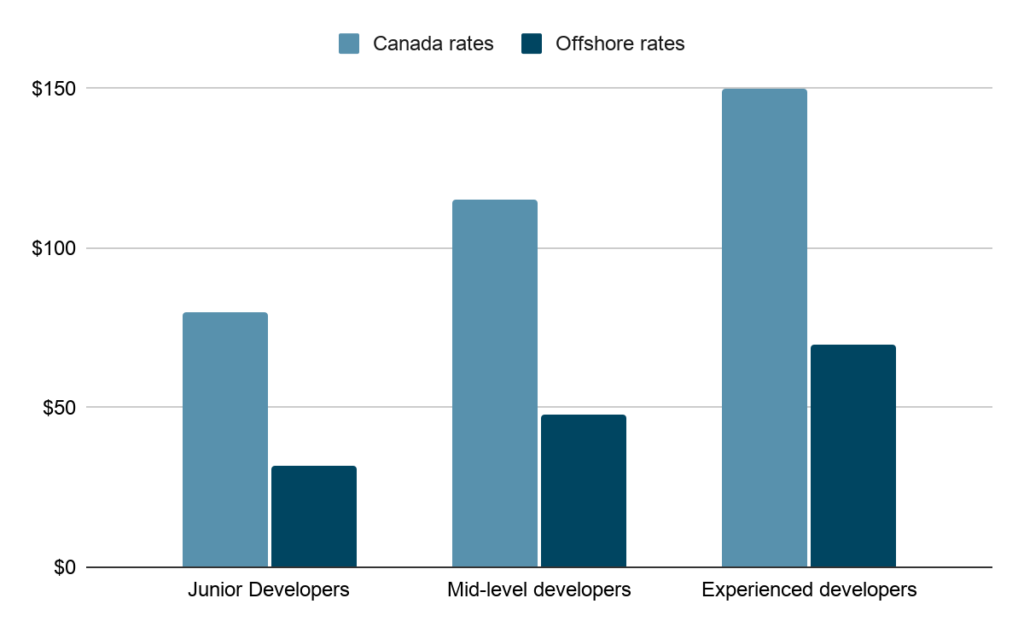
The offshore team can reduce costs by 30% to 70%. But this comes with trade-offs: zone gaps, communication overhead, and regulatory risks. Many Canadian companies today use a hybrid model, a local tech lead paired with offshore developers, for the best of both parties.
(3) Technology Stack and Architecture
Building a monolith (one big system) is faster and cheaper. Microservices (separate, independent components) cost more to build but scale much better. Choosing the wrong architecture early can mean expensive rebuilds down the road.
- Cloud-native software solutions cost more initially, but reduce long-term infrastructure overhead
- React, Node.js, and Python are widely available and cheaper to hire
- Niche stacks (COBOL, legacy enterprise) significantly increase the costs and risks
(4) Integration and 3rd-party Dependencies
Every time your software needs to ‘talk’ to another system, a payment gateway, a CRM, a logistics API, or anything, it’s the integrations. And each integration adds development time, testing time, and potential ongoing maintenance costs.
| Integration Type | Added Cost Estimate (CAD) |
|---|---|
| Payment Gateway (Stripe, Square) | $3,000 to $8,000 |
| CRM (Salesforce, HubSpot) | $5,000 to $15,000 |
| ERP (SAP, Oracle) | $15,000 to $40,000 or more |
| Custom API integration | $4,000 to $20,000 |
(5) Security and Compliance
If your business operates in a regulated industry, then compliance is a must; it’s built into the total cost of development. Canadian businesses often need to meet the following:
- PIPEDA – Canada’s federal privacy law for private-sector organizations
- PHIPA – Health information privacy law for Ontario-based health companies
- PCI DSS – Required for any software handling card payments
- SOC 2 – Common need for SaaS companies serving enterprise clients
Compliance-ready development can add 20% to 35% to your total project cost. But it is far cheaper to build it in from the start than to retrofit it later.
Software Development Cost Breakdown
(1) Cost by Development Phase
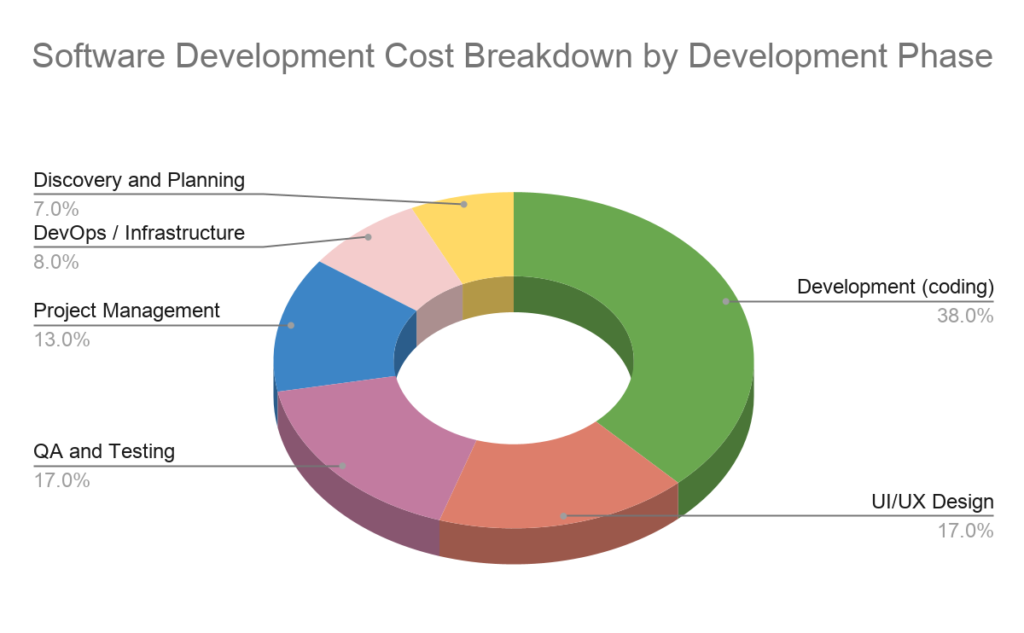
The following is something most cost guides skip, where the budget actually goes to a software project. Coding is just a single phase of the end-to-end process of development.
| Development Phase | Share of Total Budget | What It Covers |
|---|---|---|
| Development (Coding) | ~38% | Building features, APIs, backend logic, data models, and more |
| UI/UX Design | ~17% | Wireframes, prototypes, visual design, user testing, and more |
| QA and Testing | ~17% | Manual testing, automated tests, performance and security testing, and more |
| Project Management | ~13% | Sprint planning, stakeholder updates, risk management, and more |
| DevOps / Infrastructure | ~8% | Cloud setup, CI/CD pipelines, monitoring deployments, and more |
The most common budget mistake is planning only for the development (coding) part, which is just ~38% of the final budget, and forgetting about QA, design, and infrastructure, which make up the other ~62% of costs. This is where it went over budget.
(2) Cost by Software Type
| Software Type | Simple | Mid-level | Complex |
|---|---|---|---|
| Web Application | $25k to $60k | $60k to $120k | $120k to $300k or more |
| Mobile Software Solution (iOS or Android) | $40k to $80k | $80k to $160k | $160k to $350k or more |
| SaaS platform | $80k to $150k | $150k to $250k | $250k to $500k or more |
| Enterprise ERP/CRM | $150k to $250k | $250k to $400k | $400k to $550k or more |
(3) Cost by Business Size
| Business Type | Typical Budget Range (CAD) | Focus Area |
|---|---|---|
| Startup / Early Stage | $55,000 to $120,000 | Lean MVP, 3 to 5 core features, validate the idea first |
| SMB (Small-Medium Business) | $100,000 to $280,000 | Scalable systems, integrations, automation |
| Enterprise | $300,000 to $550,000 or more | Compliance-heavy, multi-region, legacy integrations |
(4) Hidden Costs
The following table shows the costs at which projects quietly go over budget. These are predictable, yet most cost estimates omit them.
| Hidden Cost | Typical Impact | Notes |
|---|---|---|
| Annual Maintenance | +15-20% of build cost per year | Bug fixes, security patches, updates |
| Scope Creep | +20-40% to project total | Every small addition compounds |
| 3rd-party tools and APIs | $500 to $2000/month ongoing | Cloud, analytics, and communications |
| Technical debt | Slows future development opportunities by 30-50% | Shortcuts today = higher costs later |
| Staff training (if needed) | $5000 to $20,000 (one-time cost) | Often overlooked in enterprise builds |
How to Estimate The Software Development Cost
You don’t need a technical background to build a perfect estimate. Follow the following five-step framework:
| Steps | Action | Detail |
|---|---|---|
| Step 1 | Define your features | List the feature you want; don’t filter yet, just note down everything |
| Step 2 | Categorise complexity | Sort each feature into basic, medium, or advanced using the complexity table above |
| Step 3 | Estimate hours per feature. | • Basic features – 20 to 50 hours • Medium features – 50 to 150 hours • Advanced features – 150 to 400 hours |
| Step 4 | Multiply by the rate | User CAD $90 to $120/hour for hybrid teams; multiply total hours by this blended rate |
| Step 5 | Add 20% buffet | Every project has hidden costs. Keep 20% contingency before finalizing your budget. |
How to Reduce Software Development Cost Without Cutting Corners
(1) Start with an MVP: Launch the core product, gather actual feedback, and then build a complete, feature-rich software.
(2) Choose a hybrid team model: Canadian oversight with global delivery efficiency.
(3) Prioritize must-have features: Defer nice-to-have features for version 1 and version 2 of your software.
(4) Invest in proper discovery upfront: A $10k scoping phase prevents a $50k rework later.
(5) Avoid switching vendors mid-project: Onboarding a new team resets weeks of context.
Build vs. Buy vs. Outsource: Which Makes Sense for You?
| Approach | Best For | Cost Profile | Control |
|---|---|---|---|
| Build in-house | Core IP, long-term product roadmap | High upfront + ongoing salaries | Full |
| Outsource | Speed, budget-conscious projects | Project-based, predictable | Moderate |
| Buy (off-the-shelf) | Standard needs, fast deployment | Low build, ongoing licensing | Low |
| Hybrid Model | Scale and IT protection | Balance, best overall ROI | High |
For most Canadian mid-size businesses, outsourcing to a local software development company in Canada or working with a hybrid team delivers the best cost-to-quality ratio. You get experienced developers without the overhead of full-time hires and a local partner who understands Canadian compliance requirements.
Why Canadian Businesses Are Choosing iQlance Solutions
As a leading software development company with Canadian roots and a distributed delivery model, we work with startups, SMBs, and enterprise clients across the country. Here’s what makes the difference when you hire software developers through iQlance:
- Local presence across Canada, and in-person meetings available in major cities
- Deep experience in regulated industries like healthcare, fintech, and logistics
- The hybrid team model, along with Canadian oversight, has global delivery efficiency
- Transparent project pricing with fixed-cost milestone options
- End-to-end capability including discovery, design, development, QA, DevOps, and maintenance
Frequently Asked Questions
- Junior developers: CAD $70-$90/hr.
- Mid-level developers: CAD $100-$130/hr.
- Senior developers: CAD $140-$160/hr.

 Previous Briefing