The Ultimate List of 10 Best Mobile Apps for Toronto Residents (in 2026)

10 Best Mobile Apps for Toronto Resident

Living in Toronto means managing transit, payments, food, and city services, often across a dozen different screens. Here is the shortlist that actually makes life easier.
Mobile Apps for Toronto Resident

Think about a regular Monday in Toronto. You need to catch the TTC, find a parking-free launch spot near King Street, send a quick invoice, and maybe meet someone after work. Those are at least four major decisions you have to make, and in 2026, there is a smarter app for each one.

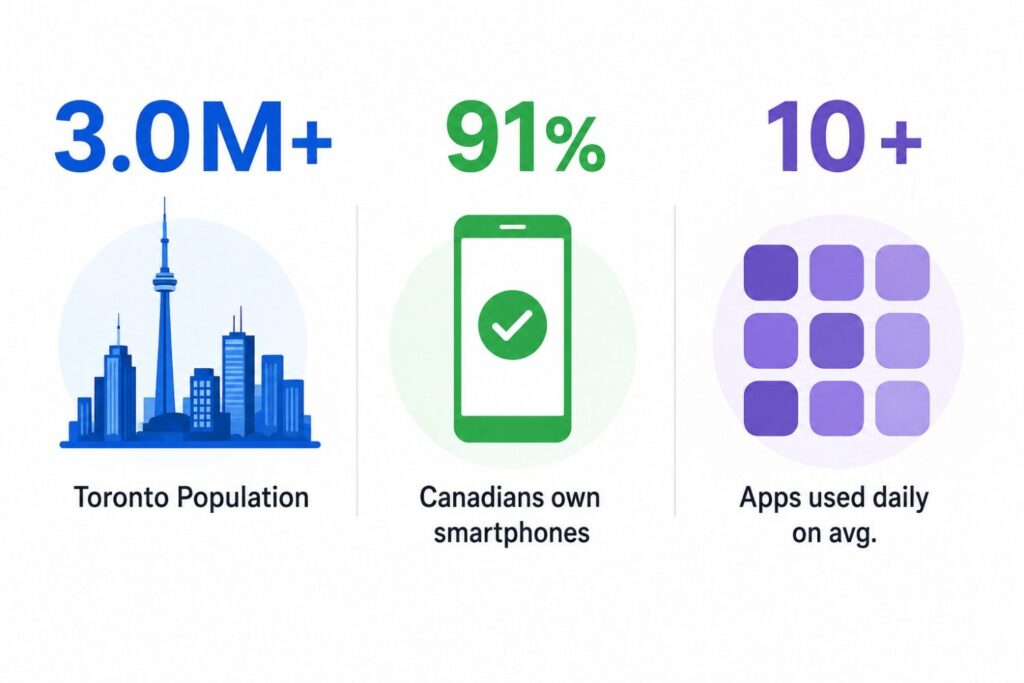
Smartphone usage in Canada has crossed the 91% mark, and Toronto residents are among the most digitally active in the country. It’s no coincidence that app development Canada-wide has become one of the fastest-growing tech sectors. The demand is right here, on every streetcar and every lunch break. But more apps don’t mean better ones.

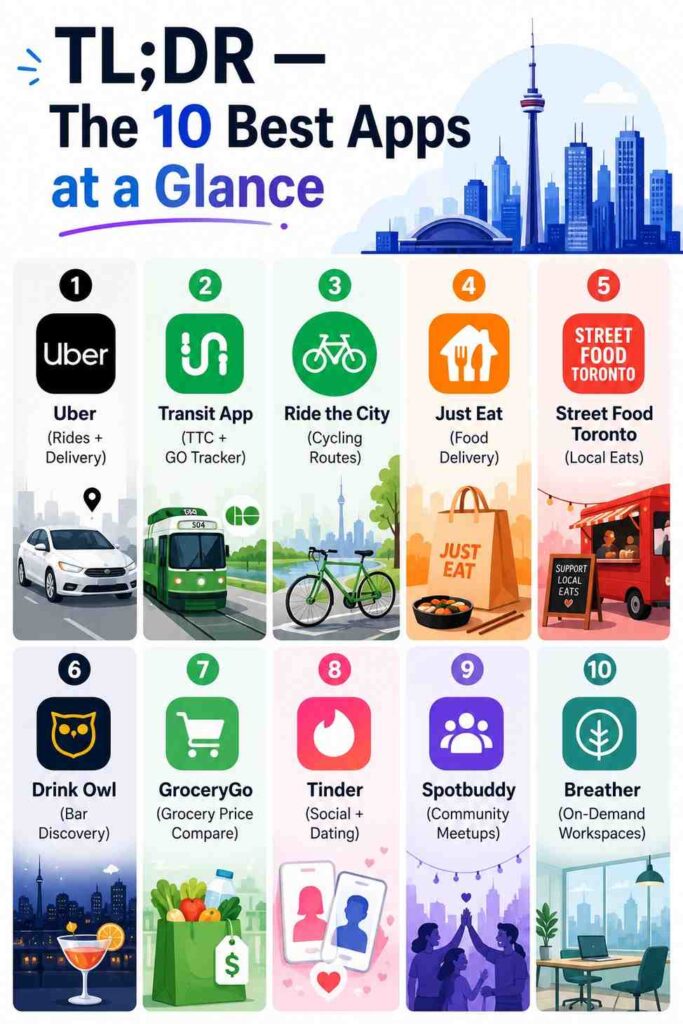
The city’s unique mix of multi-modal transit, dense neighborhoods, and a fast-paced professional culture means residents don’t need a hundred apps; they just need the best 10. This guide breaks down exactly that, organized by category, ranked by actual utility, and written for people who actually live and work here.
best mobile apps for toronto resident

Why App Choice Actually Matters in a City Like Toronto

Toronto isn’t a one-speed city. A commuter in Scarborough has different needs from a startup founder in the Financial District. A student near UofT looks for different tools than a restaurant owner on Queen West. The apps you choose quietly shape how much friction or flow you experience every single day. And as app development Toronto continues to accelerate, the tools available to residents are only getting sharper.
Why App Choice Actually Matters in a City Like Toronto

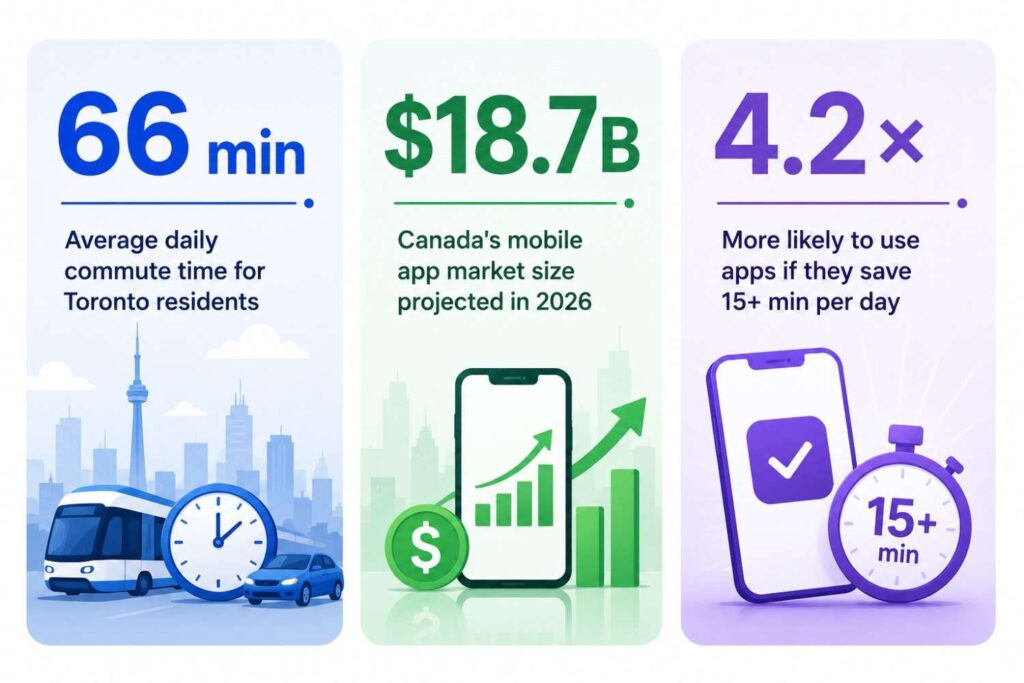
The city’s public transit network, TTC, GO, UP Express, etc., is expensive but not always predictable. That alone creates a need for real-time data apps. Add the food scene (Toronto has over 9000 restaurants), a co-working boom post-pandemic, and one of Canada’s most active social calendars, and you start to see why the average Torontonian reaches for their phone more than 80 times a day.
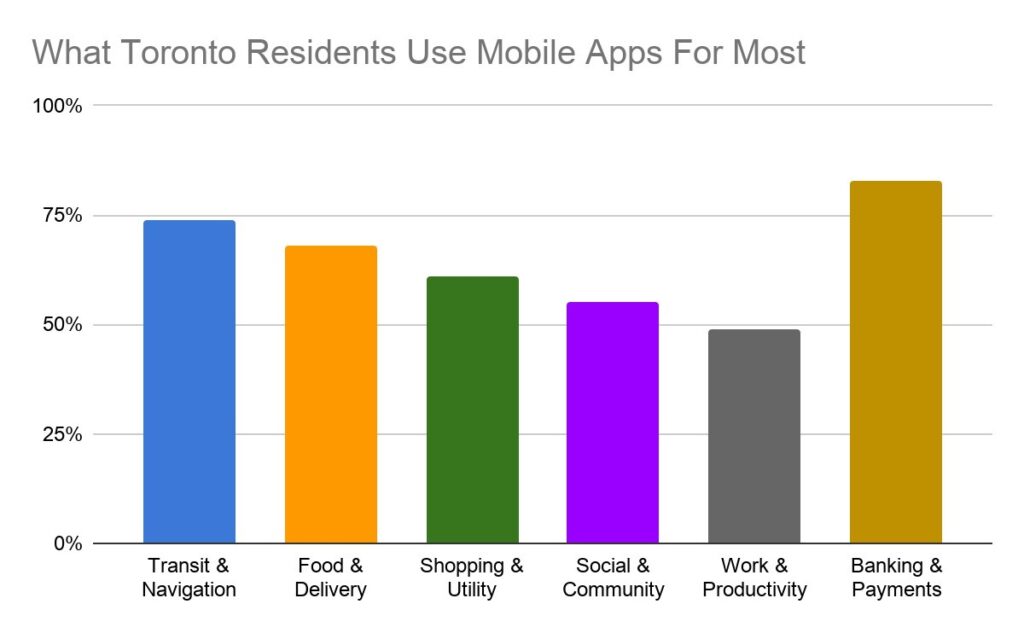
most used mobile apps in toronto

The Best 10 Mobile Apps for Toronto Residents in 2026

The following are the apps broken down by what it does, who it’s for, and why it earns its place on your phone.

(1) Uber 

(⭐ 4.8 in App Store)

Uber in Toronto is more than a ride. It is a transit fallback when the TTC is delayed, a food delivery platform via Uber Eats, and for businesses, a reliable way to move clients across the city without dealing with parking. The integration between rides, food, and Uber for business makes it the single highest utility app on this list. The best features of this app are ridesharing, parcel delivery, business billing, and real-time tracking.

(2) Transit App 

(⭐ 4.7 in App Store)

Think of this as your personal TTC dispatcher. The Transit app pulls live data from TTC buses, subway lines, GO Transit, and even Uber, displaying everything on one map. It shows you exactly how many minutes until your bus arrives (not the scheduled time, the actual time) for daily commuters. This is arguably the most important app in Toronto. The best features of this app are TTC live data, GO Transit, multi-model routing, and trip planning.

(3) Ride the City 

(⭐ 4.3 in App Store)

Toronto’s cycling infrastructure has expanded significantly, and Ride the City maps it all. The app recommends the safest, most bike-friendly routes through the city. Avoid high-traffic roads and highlight protected lanes. If you are part of the growing crowd using Bike Share Toronto or your own wheels, this app removes the guesswork from cycling in the city. The app offers cycling routes, Bike Share Toronto, safety-first navigation, etc., features.

(4) Just Eat 

(⭐ 4.4 in App Store)

Just Eat holds a unique edge over competitors in Toronto: it includes smaller independent restaurants that aren’t on Uber Eats or DoorDash. If you want to support a local Kensington Market shawarma spot or a family-run Vietnamese restaurant in Scarborough, Just Eat is where you find them. Price transparency is also notably better; you see delivery fees upfront, not at checkout.

(5) Street Food Toronto 

(⭐ 4.1 on Google Play)

Toronto’s street food scene is underrated and largely invisible unless you know where to look. Street Food Toronto maps licensed food trucks and pop-up vendors across the city in real time. It is a niche app, but it fills a real gap: finding a great launch under $12 near you. Particularly useful during summer months around the waterfront and downtown core.

(6) Drink Owl 

(⭐ 4.2 in App Store)

Drink Owl is essentially a Yelp platform built specifically for Toronto’s bar culture. It curates cocktail bars, craft beer spots, wine bars, and rooftops with filters by neighborhood, vibe, price point, and even happy hour timing. For professionals entertaining clients or a team post-work outing, it saves the “where should we go?” back-and-forth entirely.

(7) GroceryGo 

(⭐ 4.5 in App Store)

GroceryGo does one thing extremely well: it compares grocery prices across Loblaws, Metro, Walmart, Costco, and No Frills in real time so you always know which store has the lowest price on the items you actually buy. In a city where the cost of living continues to climb, this is one of those apps that genuinely puts money back in your pocket, often $30 to $50 per week for a family of four.

(8) Tinder 

(⭐ 4.0 in App Store)

Toronto is one of North America’s most diverse cities, which makes Tinder’s user base here unusually rich. Beyond just dating, the app increasingly surfaces event-based connections and shared interests. In 2026, features like ‘Tinder Explore’ make it a social discovery tool as much as a dating one. For newcomers to the city, it’s also been widely cited as a genuine way to find community.

(9) SpotBuddy 

(⭐ 4.3 in App Store)

SpotBuddy is built for shared interests; find running partners, hiking groups, sports leagues, or hobby clubs near you in Toronto. Unlike Facebook Groups (which are chaotic) or Meetup (which feels stale), Spotbuddy focuses on spontaneous, location-based activity matching. It’s especially useful for professionals and newcomers who want to build a social life beyond the office.

(10) Breather 

(⭐ 4.5 in App Store)

Breather is an on-demand workspace booking app, and it was built in Canada, making it particularly well-suited for Toronto’s downtown core. Need a quiet room for a two-hour client call? A small meeting space for 4 people near Union Station? Book it on Breather in under a minute. It’s a practical solution for hybrid workers, freelancers, and growing teams that don’t want to commit to a full office lease.

AppCategoryBest ForFree?
UberTransitRides, food delivery, business travelFree (pay per use)
Transit AppTransitDaily TTC + Go commutersFree
Ride the CityTransitCyclists and bike-share usersFree
Just EatFoodSupporting local restaurantsFree (delivery fees) 
Street Food TorontoFoodFinding food trucks and pop-upsFree
Drink OwlFoodBar & nightlife discoveryFree
GroceryGoUtilitySaving on weekly groceriesFree
TinderSocialDating, social discovery, eventsFreemium
SpotBuddySocialActivity groups + communityFree
BreatherWorkOn-demand meetings + workspacePay per booking

How to Choose the Right App Stack for Your Situation

Not everyone needs all the above-mentioned apps. Here is a simple framework based on how you actually use the city, so you are not downloading apps you will ignore.

(1) If You Commute Daily

  • Transit App (real-time TTC data) 
  • Uber (backup when transit fails) 
  • Ride the City (if you cycle) 
  • Breather (for flexible work hours)

(2) If You Run a Business

  • Uber for business (client travel) 
  • Breather (Team meeting spaces) 
  • Transit App (know your team’s routes) 
  • Drink Owl (client entertaining)

(3) If You Are New to Toronto

  • Transit App (learn the city’s routes) 
  • SpotBuddy (build a social circle) 
  • GroceryGo (learn local price benchmarks) 
  • Street Food Toronto (explore affordably)

(4) If You Are Watching Costs

  • GrocerGo (save on groceries) 
  • Just Eat (transparent delivery fees) 
  • Transit App (avoid costly Uber habit) 
  • Street Food Toronto (cheap-quality meals)

Top 4 App Trends Reshaping How Toronto Operates in 2026

The apps we have discussed are all used to solve users’ pain points. But modern tools are changing how the entire city thinks about mobility, services, and productivity. These trends matter if you are a business leader thinking about where digital products are running.

(1) AI-powered Civic Apps

Tools like SolveTO are using AI to help residents report city issues, navigate permits, and access government services in simple language, ensuring no bureaucratic jargon is needed.

(2) Super Apps + Ecosystem Bundling

Rather than 10 separate apps, platforms are building transit, payments, food, and services into one, following the WeChat model. Toronto is early, but the direction is clear.

(3) Real-time + Predictive Mobility

Apps are moving from ‘where is my bus now’ to ‘you should leave in 4 minutes based on your meeting, route congestion, and weather.’ Predictive intelligence is the new real-time.

(4) Contactless-first Economy

Cash is nearly irrelevant in Toronto’s core. From transit fares to street food, the entire urban experience is moving toward tap-to-pay and in-app payments by default.
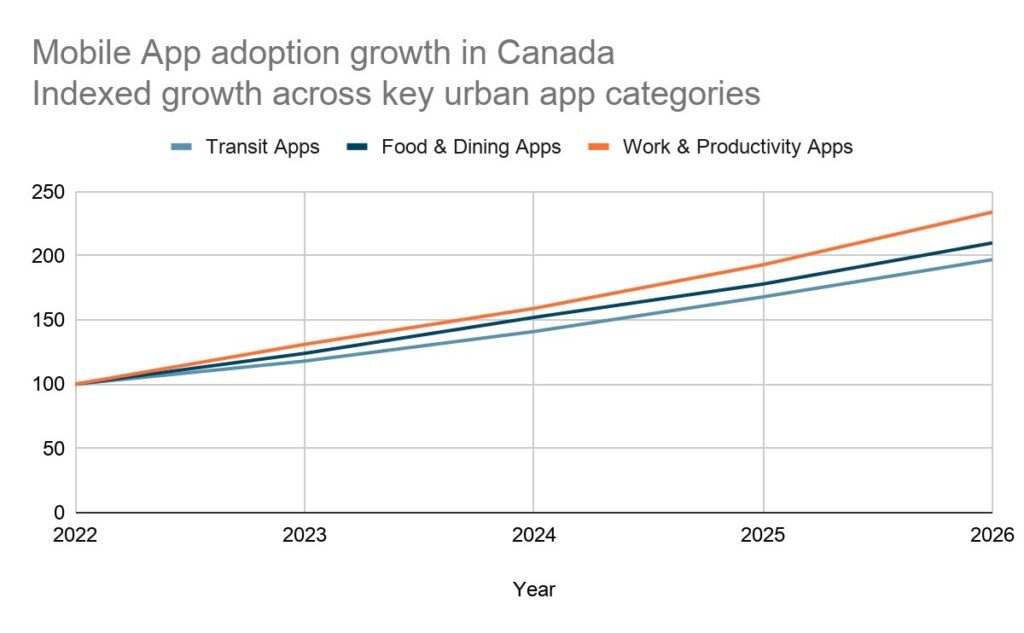
mobile app growth in toronto
(The base year here is 2022.)

What This Tells Us About Where Businesses Need to Invest

Every app on this list started as someone’s answer to a problem that wasn’t being solved well enough. Businesses across Canada, from startups to enterprises, are increasingly recognizing that a well-built mobile app isn’t a nice-to-have; it’s a competitive channel.

Whether it’s a retail brand needing a loyalty and commerce app, a logistics company wanting real-time fleet visibility, or a healthcare provider building a patient engagement tool, the underlying challenge is always the same: turning an idea into a reliable, well-designed product that people actually use.

That’s where a trusted mobile app development company comes in. The most successful mobile products in 2026 share a few traits: they solve one problem extremely well, they’re built with a mobile-first mindset, and they’re maintained iteratively based on real user feedback.

Building a mobile app for the Canadian market?

iQlance helps Canadian businesses design, develop, and launch mobile apps from MVPs for startups to feature-rich apps for enterprises. Let’s talk about what you want to build. Contact us now, or explore our portfolio to know more about us.

Conclusion

Apps Are Infrastructure… and Toronto Proves It

A decade ago, “Which apps do you use?” was a casual conversation. In 2026, it’s closer to asking someone how they get around, eat, work, and connect with people. The ten apps in this list aren’t unique; they’re part of how Toronto actually functions.

The real message is not just which apps to download. It’s that every one of these products was built to solve a specific, real problem for a specific group of people. That clarity of purpose is what separates apps people actually use from the 80% that get deleted within a week.

For businesses, the lesson is equally clear: mobile is not a feature your product might eventually need; it’s often the primary way your customers, employees, or partners will interact with you. The companies investing in thoughtful app development Canada-wide today are building the infrastructure their businesses will run on tomorrow. Whether you choose to work with a mobile app development company or hire dedicated developers to work directly within your team, the important thing is starting with clarity: who is this app for, what problem does it solve, and what does success look like in 90 days?

If you’re at the stage of thinking about what it would take to build something for the Canadian market, whether that’s a customer-facing app, an internal tool, or a full product, the smartest first step is talking to a team that’s done it before. Learn how iQlance approaches mobile app development in Canada.
Mobile App Development Trends Businesses Must Know 2026

mobile-app-development-trends-2026

If you think having an app is enough to build an online presence, I am sorry to say you’re headed in the wrong direction. Because it needs the right app, flawless software that fits your targeted niche, and a leading mobile app development company that understands your business goals. The business’s growth today depends on how well its app connects with target users, streamlines operations, and keeps things moving in a highly competitive market. 

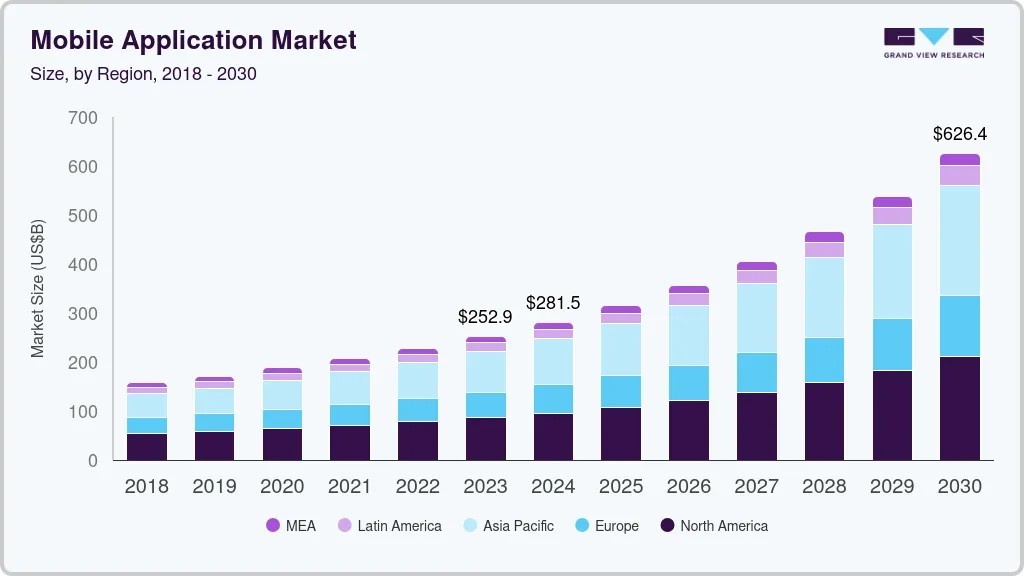
According to Grand View Research, the global mobile application market was valued at USD 252.89 billion in 2023 and is projected to reach USD 626.39 billion by 2030, growing at a CAGR of 14.3% from 2024 to 2030. These numbers clearly show how deeply mobile experiences now shape how businesses operate and how people interact with brands every day.

Users raised the bar; they don’t want just an app; they want something that feels personal, quick, and smooth, using AI, AR/VR, 5G, and cloud technology to make each tap feel effortless. If you are planning to grow your digital presence, 2026 is the right time to execute your plans. In this blog, we will discuss the latest mobile app development trends for 2026 and how to choose the best one for your business. 

Top 12 Mobile Apps Development Trends in 2026 

The following is the comprehensive list of the top 12 mobile app development trends in 2026 that every business should know.

(1) AI Native and On-device Intelligence 

AI has moved from backend support to the core architecture of mobile apps. What is changing in 2026 is where AI operates on-device instead of purely cloud-based. This means apps can process data locally, making them faster, more secure, and highly responsive, even without internet connectivity. 

What this looks like in real life: 

  • Apps adapting layouts based on user habits
  • Auto-reply suggestions to messaging apps 
  • Real-time photo improvement without uploading raw images 
  • Voice assistants working offline 
💯 Fact Check 
Apps using on-device AI can reduce latency by up to 60% to 80% compared to cloud-dependent models.
User BenefitsEnterprise Benefits
Instant responses without lag, even in low connectivity areas.Reduced dependency on cloud infrastructure lowers long-term costs.
Stronger privacy since data stays on the device.Better compliance with strict data protection regulations.
Offline functionality for key features.Improved app reliability and uptime.
Personalized experience that grows in real time.Higher user engagement due to smarter interactions.

(2) 5G-enhanced Mobile Experiences

Here, 5G is not just showing high speed, but it is all about offering experiences that were previously not possible on mobile devices. Enabling ultra-low latency and high bandwidth, apps can now offer real-time and data-heavy interactions seamlessly. 

Where users feel the difference:

  • Buffer-free 4K and 8K video streaming 
  • Lag-free multiplayer gaming 
  • Real-time AR navigation 
  • Instant cloud sync
User BenefitsEnterprise Benefits
Lightning-fast app loading and smooth navigation.Ability to build high-performing and feature-rich apps.
Seamless streaming and gaming without interruptions.Increased user satisfaction and app ratings.
Real-time collaboration and communication.Better engagement metrics and session duration.
Improved AR/VR experiences.Opportunity to develop new ideas with comprehensive features

(3) Cross-platform & Low-code/No-code Development 

Speed is the topmost priority in apps nowadays. Cross-platform development ensures apps run on multiple OS (operating systems) using a single codebase, while low-code or no-code tools simplify the development process. This combination is making app development quick, more efficient, and scalable. 

Many businesses are now collaborating with an experienced app development company like iQlance Solutions to leverage these tools without compromising quality. 

Why is this trend growing?

  • Quicker prototyping and deployment 
  • Reduced development complexity 
  • Easier updates across platforms
User BenefitsEnterprise Benefits
Uniform experience across Android and iOS devicesSignificant reduction in development time
Faster feature updates and bug fixingLower development and maintenance costs
Stable and consistent performanceFaster go-to-market strategy
Better app reliabilityEasier scalability for future features

(4) Touchless UI 

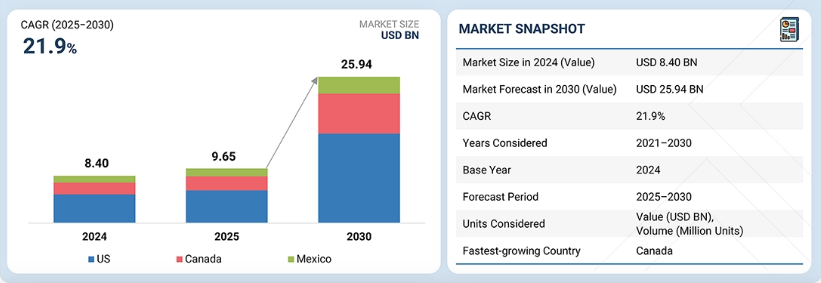
The trend of touchless UI is growing rapidly, and users are widely expecting it in mobile apps. Because touchless interfaces are transforming how users interact with apps. Instead of tapping screens, users can now control apps using voice, gestures, or even facial recognition (the latest update). This trend is making apps more intuitive, accessible, and convenient. The following image shows the growth of touchless UI in the US, Canada, and Mexico.

💯 Fact Check  
Voice-based interactions are expected to power over 50% of mobile searches in the near future.
User BenefitsEnterprise Benefits
Interaction improves convenience in daily use because there is no need to use your handsExpands accessibility for differently-abled users 
Faster task completion without manual inputIncreased adoption across wider user segments 
Improved hygiene and safety in public environmentsHigher engagement due to ease of use
More natural and intuitive app navigationStronger brand perception as innovative 

(5) Hyper-personalization With AI Analytics 

Nowadays, users expect apps to feel ‘custom-made’ for them. Hyper-personalization uses AI and data analytics to customize every aspect of the app experience. This goes far beyond simple recommendations; it reshapes the entire user journey. 

How apps personalize experiences:

  • Dynamic content feeds 
  • Personalized notifications 
  • Behavior-based UI changes 
  • Predictive suggestions
User BenefitsEnterprise Benefits
Contact and features custom to individual preferencesHigher conversion rates and sales
Reduced time spent searching for relevant information Better understanding of user behavior
More meaningful and engaging interactions Increased retention and lifetime value
Personalized offers and recommendationsImproved ROI from marketing efforts
Future outlook: 

The global hyper-personalization market is projected to grow from US $25.73 billion in 2025 to US $58.34 billion by 2030. This reflects strong demand for intelligent personalization solutions.

(6) Apps For Foldable and Wearable Devices 

With the growing demand for foldable smartphones and wearable devices like smartwatches, apps must now adapt to multiple screen sizes and interaction styles. This trend is pushing developers to think beyond traditional layouts. Teams specializing in app development Toronto are already focusing on adaptive UI/UX for these emerging devices. 

What’s changing:

User BenefitsEnterprise Benefits
Smooth experience across various device typesAccess to new and growing device markets
Better multitasking capabilitiesOpportunities to innovate with unique app features
Improved usability on smaller screensIncreased user engagement across devices
Seamless device connectivityFuture-proof app development strategy

(7) Predictive Analytics 

Predictive analytics allow apps to think ahead. Instead of reacting to user actions, apps anticipate needs and provide proactive solutions. 

Actual applications:

  • Predict the next purchase 
  • Suggesting routes based on traffic patterns 
  • Recommending content before search
User BenefitsEnterprise Benefits
Reduced effort in searching or navigatingMore accurate targeting and recommendations
Faster decision-making with relevant suggestionsIncreased conversions and sales
Smarter and more intuitive app experienceData-driven product improvements
Time-saving interactionsStronger competitive positioning

(8) Extended Reality (XR) 

Extended Reality (AR, VR, and MR) is turning mobile apps into immersive environments where users can interact with digital content in real-world contexts. 

Where users see XR:

  • Virtual try-ons in shopping apps 
  • Interactive gaming experiences 
  • AR-based learning tools
  • Virtual tours and simulations
💯 Fact Check  
XR adoption in mobile apps is growing rapidly, with user engagement increasing by over 40% in comprehensive experiences.
User BenefitsEnterprise Benefits
Highly interactive and engaging experiencesStrong differentiation in crowded markets
Better visualization before making decisionsIncreased conversion rates
Improved learning and entertainmentImproved customer engagement
Real-world interaction with digital contentInnovative brand positioning

(9) Advanced Mobile Security and Privacy 

Security is not an option; it is a fundamental expectation. Users demand transparency and control over their data. Cutting-edge apps are implementing advanced security measures to protect sensitive information. 

Leading mobile app development companies in Canada use various cutting-edge technologies, including biometric authentication (fingerprint, face ID, or more), end-to-end encryption, secure APIs, and zero-trust architecture, to ensure high-tech security of the application.

💯 Fact Check  
Over 80% of users are more likely to trust apps that clearly communicate data protection practices.
User BenefitsEnterprise Benefits
Strong protection of personal and financial dataReduced risk of cyberattacks and breaches
Secure transactions and communicationCompliance with global regulations
Greater control over privacy settingsIncreased user trust and loyalty
Compliance with data-protection law ensures data is safe while using appsStronger brand credibility

(10) Blockchain and IoT-Integrated Mobile Apps 

The combination of blockchain and IoT builds secure and connected mobile apps. Blockchain ensures transparency and data integrity, while IoT enables real-time communication between devices. 

Smart home automation, secure financial transactions, supply chain tracking, connected healthcare devices, etc., are some use cases of blockchain and IoT-integrated mobile apps.

User BenefitsEnterprise Benefits
Transparent and tamper-proof transactionsReduced fraud and data manipulation risks
Seamless connectivity between devicesImproved operational efficiency
Real-time updates and monitoringBetter data accuracy and tracking
Improved trust in digital interactionsAutomation of complex processes

(11) Instant Apps (Try-Before-Install Experiences) 

Instant apps allow users to use apps without downloading them. Users can get access to all app features instantly. Instant apps or try-before-install experiences reduce friction and improve user onboarding. 

These apps don’t need storage; users can get instant access, and they can make quick decisions whether they want to download or not. These are some advantages of the Instant apps for which this model is trending in 2026. Moreover, the apps that give instant experiences can improve conversion rate by 20% to 30%, as per the study; hence, businesses are widely adopting this approach.

User BenefitsEnterprise Benefits
No need to install full appsIncreased user acquisition rates
Saves mobile storage spaceReduced drop-offs during onboarding
Get immediate access to featuresHigher conversion from trial to install
Faster and smoother interactionsBetter first impression

(12) Sustainable or Green App Development 

Sustainability is becoming the first priority for businesses, which is why businesses nowadays widely shift to green app development. These are the apps that focus on lowering energy consumption and optimizing performance. 

These apps include writing efficient code, minimizing server usage, and optimizing app performance. The MVP app development approach supports sustainability by building only essential features first, avoiding unnecessary resource usage. 

Sustainable practices include the following:

  • Lightweight app design 
  • Energy-efficient coding 
  • Reduced background processes 
  • Optimized data usage
User BenefitsEnterprise Benefits
Longer battery life and better device performanceLower infrastructure and energy costs
Reduced data consumptionPositive environmental impact
Smooth and efficient app performanceStronger brand reputation
Eco-friendly digital usageAlignment with sustainability goals

Steps To Follow While Choosing Mobile App Trends for Your Business in 2026

The following are the steps you must follow while deciding on the mobile app development trend that suits your business.

(1) Business Impact & Revenue Alignment 

Firstly, understand how a trend will improve revenue generation, customer retention, operational efficiency, and competitive differentiation. If you don’t get a clear answer, skip that particular trend. Hire dedicated developers and follow a particular trend only when they support measurable business outcomes. 

(2) Relevant to User Experience 

Implementation of the mobile app development trend demands significant time and cost investment. So, you have to ensure that the end users get something valuable from it. Here, you have to evaluate whether the trend improves usability, personalization, performance, or engagement for your end users. Partner with a leading mobile app development company to ensure the trend you are following is solving real user pain points. 

(3) Scalability and Architectural Fit 

You have to check whether the existing infrastructure is able to support the trend you want to implement or not. Here, the app development company you partner with will guide you further if the trend needs to be replaced or the infrastructure needs to be changed. 

(4) Regulatory and Security Implications 

Analyze compliance requirements, data governance impact, and risk exposure. Partnering with iQlance Solutions, a leading app development Toronto company, helps you to understand all the legal implications and security needs your app requires. 

(5) Long-term Sustainability and ROI 

While implementing an emerging mobile app development trend, one must consider all factors, including implementation cost, maintenance complexity, talent availability, and future adaptability. The right trend balances long-term sustainability and ROI.

Take the Next Step With iQlance Solutions

Building a successful mobile app in 2026 is not just about following the development trends; it is all about choosing the right approach, the right technology, and the right team to bring your idea to reality. Whether you are planning for a new app or upgrading an existing one, having the right development partner can make all the difference. 

iQlance Solutions focuses on turning ideas into meaningful digital experiences that users actually enjoy. As a trusted mobile app development company, our approach is centered around understanding user behavior, designing intuitive interfaces, and building scalable, future-ready applications. The following is how we help you move forward with confidence: 

We offer end-to-end mobile app development services in Canada, from planning to deployment and post-deployment support too. Our approach ensures transparency, efficiency, and quality while helping you clearly understand and optimize the app development cost in Canada

Whether you want to build the app from scratch or want to improve an existing app, iQlance Solutions provides the expertise and support you need to move forward with confidence and build something truly impactful.

Frequently Asked Questions

AI is making apps smarter by enabling real-time personalization, predictive recommendations, and on-device processing for a faster and more secure user experience.

It allows developers to build apps for multiple platforms using a single codebase, reducing development time & cost, and ensuring a consistent UX. iQlance Solutions has hands-on experience building cross-platform apps. Connect with us to know more.

With increasing cyber threats, users expect strong data protection through encryption, biometrics, and secure authentication methods.

These trends make apps faster, more personalized, secure, and immersive, significantly improving overall user satisfaction.

Key factors include target audience, scalability, security, performance, and alignment with the latest technology trends.