POC vs Prototype vs MVP: Key Differences & What to Build First
Introduction
Every software idea starts with a problem to solve. The hard part is deciding how much to build before you have proof that the software idea will work. Starting with a product can mean months of coding, a large budget, and many untested guesses.
There is a good reason to validate those assumptions early. CB Insights’ 2026 analysis of 431 failed VC-backed companies found that 43% cited product-market fit as a reason for failure.
Before investing, a business must answer questions. Is the technology capable of delivering the software idea? Will users want the proposed experience? Importantly, will customers actually use the product when it reaches the market?
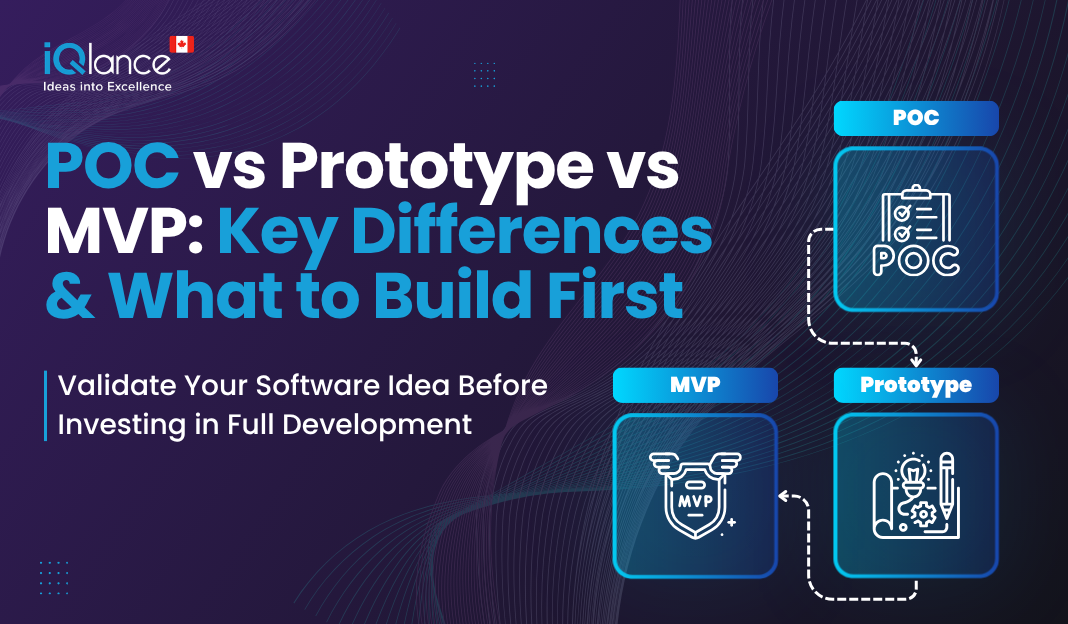
A Proof of Concept (POC), a Prototype, and a Minimum Viable Product (MVP) are approaches that address these questions at different stages. POC focuses on feasibility. A prototype explores the product experience. MVP gives a working version to users to test market demand.
The real challenge is figuring out which approach makes sense for the software idea. You may not need all three. Starting with the approach can waste a lot of time and resources.
This guide explains POC, Prototype and MVP. This guide tells you when each approach is useful and helps you decide what to build.
POC vs Prototype vs MVP: What’s the Difference?
A POC, Prototype, and MVP can all be used to reduce uncertainty before a business commits to building a complete software product. The difference lies in the type of uncertainty each addresses. Choosing between them is less about how much software you build and more about what you need to learn first.
Proof of Concept: Check the Technical Idea
A POC is suitable when people are unsure if the underlying technology can support the idea. The effort is usually focused on one or more challenges rather than on the finished product.
For example, a business might want to create an application that uses an AI model to analyze data in real time. Before spending money on the application, the development team can test if the model can process the needed data accurately and quickly enough.
The POC may never resemble an application. Its value is in showing that the hard technical part can be done.
Prototype: Explore the Product Experience
A Prototype focuses on what happens from the user’s perspective. It can represent the screens, navigation, interactions, and key steps a user would take while using the product.
Consider a new online booking platform. Before developers build the booking system, a business can create an interactive Prototype showing how customers search, select an option, choose a time, enter their details, and confirm a booking. Stakeholders and test users can review this flow and identify problems while changes are still relatively easy to make.
The Prototype therefore helps turn an idea into something people can see and interact with before significant development begins.
MVP: Test the Product With Real Customers
An MVP is a working version of a product that includes the essential features needed to solve the target problem. It is not an incomplete or unfinished version of the final product. The aim is to launch with enough functionality to provide real value while keeping the initial scope focused.
For example, a new food delivery business may begin with customer registration, restaurant listings, ordering, payment, and basic delivery tracking. Features such as loyalty programmes, advanced recommendations, and other additions can be added later if customer feedback indicates they are worth building.
An MVP gives the business something usable in the real market. Customer feedback, usage patterns, and business results can then help shape future development.
In simple terms, a POC helps prove that the technology can work, a Prototype helps shape how the product should work, and an MVP helps determine whether the product is worth taking further. The right choice depends on which question needs an answer first.
| Comparison Table |
| Factor | POC | Prototype | MVP |
| Main purpose | Technical feasibility | Design and user experience | Market validation |
| Main question | Can we build it? | How should it work? | Will people use it? |
| Focus | Technology and technical risks | UI/UX, design, and user flow | Core features and customer needs |
| Users | Internal team and technical stakeholders | Stakeholders and selected test users | Real customers and early adopters |
| Output | Technical proof or test result | Interactive product model | Working software product |
| Typical testing | Technology, APIs, integrations, and algorithms | Navigation, screens, workflows, and usability | Customer behaviour, feedback, and demand |
| Level of functionality | Limited technical functionality | Mostly visual or interactive | Functional core features |
| Key outcome | Confidence that the technical idea is possible | Confidence in the product experience | Evidence of market interest and product value |
What Should You Build First?
Choosing between a POC, Prototype, and MVP should not be based on what other businesses are doing. The right starting point depends on the biggest uncertainty behind your product idea. Before investing in development, identify what you need to prove first.
Choose a POC if the technology is uncertain
A POC makes sense when the product depends on technology that has not been proven in your specific use case. This could include artificial intelligence, complex algorithms, advanced data processing, or multiple third-party integrations.
For example, if you want to build an application that uses AI to analyze images, the first question may be whether the technology can deliver accurate results. Proving this early can prevent you from investing in a full product before knowing whether the technical foundation will work.
Choose Prototype if you are not sure about the user experience.
A Prototype is a way to start when you already know how the technology works but do not know how people will actually use the product. I find this approach very helpful for products with different screens, complex workflows, or many different user roles.
Testing the product flow before you start development can help you identify confusing navigation or unnecessary steps. It is much easier to fix these mistakes before you spend too much time building everything.
Choose an MVP if you are unsure about market demand.
An MVP is the choice when the technology works, and the product concept is clear, but you still need to see how real customers react to the idea. Instead of building every single feature you planned, you should just launch the most important parts and learn from how people use those parts.
For example, a startup might have a solution and a simple technology stack but no proof that customers will actually use or pay for the product. A focused MVP can give you that proof by using real-world feedback from people.
A Simple Decision Flow
Technical uncertainty- POC
Design or UX uncertainty- Prototype
Market uncertainty – MVP
You also do not have to follow all three stages. If the technology has already been proven, a POC may add little value. If the user journey is simple and well understood, you may not need a detailed Prototype. Likewise, if both technical and UX risks are low, moving directly toward an MVP may be the most practical option.
The goal is not to build more. It is to validate the most important assumption before making the next major investment.
In simple terms, a POC tests whether the technology can work, a Prototype tests how the product should work, and an MVP tests how the market responds to the working product. The right choice depends on the question that needs to be answered first.
Selecting an Appropriate Development Team
Not every company has a technical team on staff, and starting one from scratch is not always possible. Getting help from outside can be a choice when you need special skills, have complicated tech needs, or want to go fast from planning to building.
When you hire software developers, look for more than coding skills. The best team should know your business goals, who your users are, what tech you need and what limits you have. Having experience can also help the team spot problems early. Suggest the best way to build things.
A software development company can be useful when a product uses technology, integrates with other services, runs on multiple devices, or requires regular updates. A good partner should know what to check, set the project plan, and decide whether a test, a model, or a basic version is right without making the project too big.
Before choosing the right Software Development Company, check their skills and experience with similar projects. Doing so can make a significant difference to your product’s success. Make sure the plan and what you want are clear and keep talking during the project. Testing and quality checks are also important to make sure the product works well before it’s ready.
Consider the post-launch phase of the partnership. End users may identify additional requirements, technical challenges, or areas for enhancement. Your development partner should be capable of delivering ongoing support, implementing updates, and facilitating further development as the product matures.
The best development partner is not simply the team that can build the product. It is the team that understands what your business needs to validate before deciding what to build.
Why Choose iQlance for MVP Development?
Creating an MVP is not about adding as many features as possible. It is about figuring out what the product needs to do and building features to test the idea with real users.
At iQlance, we begin by learning about your business idea, the people you want to reach and what you want your product to do. We then help you pick the features and make a solid plan for the first version.
Our MVP App Development Services include UI/UX design, product development, testing to ensure it works well, and release to users. We make sure the product is helpful and works properly, without adding unnecessary features at the start.
After launch, we gather user feedback to identify improvements and new features. We can help with new features, make the product faster, and grow it as your business expands.
This way, companies can start with a product, learn from actual users and decide what to do next with better information.
Conclusion
Choosing between a POC, Prototype, and MVP is less about following a fixed development process and more about understanding what needs to be validated first. A POC proves whether the technology can support the idea. A Prototype gives shape to the product experience and helps identify usability issues. An MVP takes the core concept to real users and tests whether there is genuine market demand.
Not every business needs to build all three. If the technology is already proven, a POC may add little value. Likewise, a Prototype may not be necessary when the product flow is already well understood. The important thing is to identify the biggest uncertainty before committing significant time and money to development.
At iQlance, we help businesses evaluate their product ideas, choose the right development approach, and build with a clear path from validation to launch. If you are unsure what to build first, let’s discuss your idea and find the right starting point.
Contact us today.
Frequently Asked Questions

 Previous Briefing